Legal experts question IHC order during army’s deployment in capital


ISLAMABAD: The legality of orders passed by the Islamabad High Court (IHC) when the army was deployed in Islamabad has become questionable as a constitutional provision barred the court from doing so.
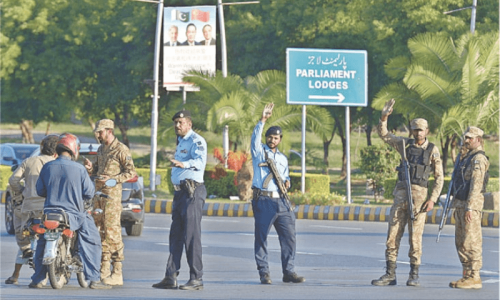
During the two-day Shanghai Cooperation Organisation summit last week, the federal government invoked Article 245 of the Constitution and called the army for security duties from Oct 5 to 17.
Subsection 3 of Article 245 bars any high court from issuing orders “in relation to any area in which the Armed Forces [are deployed]”.
The subsequent clause of this Article says: “Any proceeding in relation to an area referred to in clause (3) instituted on or after the day the armed forces start acting in aid of civil power and pending in any High Court shall remain suspended for the period during which the armed forces are acting.”
Article 245 bars court from giving verdicts about area where forces are deployed
However, the court issued orders on several petitions regarding the issues in Islamabad, where the army was deployed.
One of the petitions was filed by local traders after fierce clashes between police and PTI workers who tried to reach D-Chowk for a protest earlier this month.
The traders sought directives for relevant authorities to restore law and order during PTI’s protest at D-Chowk.
The high court ordered the police and district administration to restore law and order during the SCO summit.
Another petition was filed by the Khyber Pakhtunkhwa government against the Capital Development Authority, which had sealed KP House for allegedly violating building laws.
On another petition, IHC ordered authorities to recover PTI’s lawyer Intizar Hussain Panjhuta, who went missing from Islamabad.
The IHC chief justice also issued directions to authorities to arrange a meeting between former prime minister Imran Khan and his sister Noreen Niazi and ensure proper medical facilities for the detained leader.
No legal standing
According to legal experts, IHC’s orders on these petitions when the army was deployed in Islamabad had “no legal effect”.
Legal expert Mohammad Akram Sheikh explained that Article 199 empowers the high court to take up any matter “if it is satisfied that no other adequate remedy is provided by law.”
The said article empowers a high court to issue orders on a petition “if it is satisfied that no other adequate remedy is provided by law”.
According to Mr Akram, the high court can annul the proceedings initiated without any lawful authority under Article 199.
Similarly, the court is also empowered to order government officials to fulfil their duties or correct an abuse of discretion.
It can also restrain someone from taking certain actions, question public office holders and decide habeas corpus petitions related to unlawful detention.
However, high courts can’t hear petitions on these issues when Article 245 is invoked.
Pakistan Bar Council (PBC) Vice Chairman Farooq H. Naek said that constitutional provisions suspended the high court’s jurisdiction when Article 245 had been invoked and IHC judges could not pass any orders after Oct 4, when the army was called in.
Senior lawyer Shah Khawar said it was the attorney general and advocate general’s responsibility to properly assist the court on Article 245.
He said the orders issued on petitions filed while the army was acting in aid to civil power were without any legal force.
He pointed out that Article 5 of the Constitution makes “obedience to the Constitution” obligatory on every citizen.
This provision was contradicted when IHC exercised its jurisdiction under Article 199 when Article 245 was in place, Mr Khawar added.
An IHC official said the Interior Ministry’s notification to deploy the army was not addressed to the high court.
The army was called in aid of civil power to maintain law and order, and the government did not issue any subsequent order for the IHC, he added.Additional Attorney General Barrister Munawar Iqbal Duggal said the attorney general’s office had previously raised the objection before a bench. However, it was overruled on the grounds that the high court can examine the conduct of civil bureaucracy even if Article 245 was in place.
Published in Dawn, October 20th, 2024