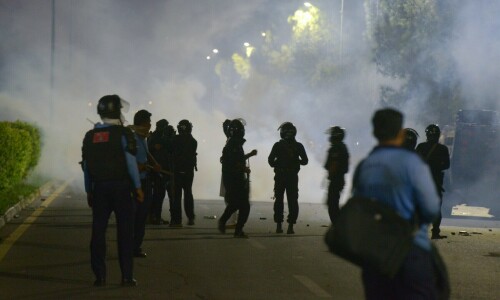
IT is déjà vu once more. Over the last couple of days, we have once more witnessed an intense stand-off in Islamabad between law-enforcement agencies and the PTI, highlighting the precarious state of political dissent in the country.
On the one hand, the government’s blocking of mobile phone signals, deployment of around 6,000 law-enforcement personnel and of barricades made from 600 shipping containers, the use of anti-riot gear, and hundreds of arrests in the capital raises troubling questions about the suppression of democratic rights. One wonders whether such actions were proportional to the alleged threat posed by the protests. Calling in the army raises further questions about the government’s ability to handle internal security through civilian law enforcement. Are the police not capable of managing a political protest? Army deployment in aid of civil power should always be a last resort.
On the other hand, however, the PTI’s confrontational approach and its history of stirring unrest cannot be ignored. At the heart of these protests is the party’s quest for ‘haqeeqi azadi’ (true freedom), with demands that include the release of their leader and claims that it is fighting for the independence of the judiciary, and a reduction in inflation.
Timing plays a crucial role in such developments. The protests are taking place just as Imran Khan and his wife were set to be indicted in another high-profile Toshakhana case, and as Pakistan prepares to host the SCO summit. The dual pressure on the government might explain its hard-line approach, but it risks exacerbating political divisiveness at a time when the country needs unity and stability.
At the time of writing, the mixed reporting surrounding the possible detention of the KP chief minister triggered further concerns. The presence of Rangers at KP House in Islamabad and the PTI’s claim that the CM was being targeted for arrest have raised eyebrows. Some speculate that the government is seeking to impose governor’s rule in KP, a move that would only exacerbate the crisis.
The tumult in Islamabad and adjacent areas — and the smaller protests in Lahore — reminds one of the four-month protest undertaken by the PTI and PAT in 2014, which was at times violent, paralysing the capital for four months. Both sides — the government and the PTI — need to step back and reassess their approaches. The government must ensure that its actions respect the democratic right to peaceful protest, while the PTI should not allow its demonstrations to turn violent and fuel unrest.
Both sides need to realise that it is the people who suffer when their lives are disrupted due to blockades and the possibility of violent protests. The warring sides must rein in their worst impulses and prioritise the nation’s well-being over short-term gains.
Published in Dawn, October 6th, 2024