Shares at PSX shed nearly 200 points on geopolitical tensions

Shares at Pakistan Stock Exchange (PSX) traded in the red on Monday, shedding nearly 200 points.
The benchmark KSE-100 index plunged 730.69 points, or 0.9 per cent, to stand at 80,561.44 points from the previous close of 81,292.13 points at 1:23pm. The index closed at 81,114.20, down by 177.93 points, from the previous close.
Awais Ashraf, director research at AKD Securities, noted that the “selling pressure in two major stocks, Hub Power and Mari Petroleum, is weighing down the index”.
“Hub Power’s decline is attributed to the threat of revision of power plant contracts, while Mari Petroleum is under pressure following the distribution of bonus shares to investors,” he said.
“Despite this, we anticipate that the approval of the IMF Extended Fund Facility will have a positive impact on the economy, as it ensures that the external account remains fully funded,” he added on a positive note.
He observed the such a development could lead to further monetary easing and subsiding inflationary pressure, adding that investor interest was likely to “remain focused on stocks with higher dividend yields and those poised to benefit from monetary easing”.
Meanwhile, Shahab Farooq, research director at Next Capital Limited, attributed the bearish momentum to the “overall situation in [the] Middle East making investors nervous”.
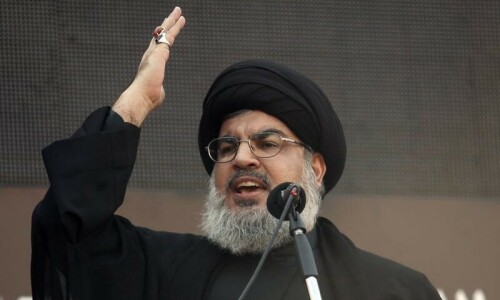
Regional tensions in the Middle East have amped up geopolitical uncertainty after Israel assassinated Hassan Nasrallah, the top leader of Lebanese group Hezbollah, on Saturday. It continued its attacks on Monday, killing a Hamas figure as well as three Palestinian leaders in Lebanon.
Moreover, the US has also indicated it was increasing its air support capabilities in the Middle East and putting troops on a heightened readiness to deploy to the region.
Meanwhile, share markets turned hesitant in the Asian region as strife in the Middle East offset more policy measures in China, while the Nikkei dived on concerns Japan’s new prime minister favoured normalising interest rates.
The stimulus rush in China did help outweigh a poor manufacturing survey and lift the blue-chip CSI300 another 7.7pc, having already jumped 16pc last week.
Continued Israeli strikes across Lebanon added geopolitical uncertainty to the mix, though oil prices were still restrained by the risk of increased supply.
The week is packed with major US economic data including a payrolls report that could decide whether the Federal Reserve delivers another outsized rate cut in November.
The Nikkei led the early action with a dive of 4.6pc as investors anxiously waited for more direction from new Prime Minister Shigeru Ishiba, who has been critical of the Bank of Japan’s easy policies in the past. However, he sounded more conciliatory over the weekend saying monetary policy “must remain accommodative” given the state of the economy.
Major stock markets in the Gulf also fell in early trade amid rising tensions in the region, with the Saudi index on course to extend losses a day after it snapped a seven-day winning streak.
Saudi Arabia’s benchmark index eased 0.1pc, with Saudi National Bank, the country’s biggest lender, falling 0.7pc.
Dubai’s main share index dropped 0.3pc, hit by a 0.6pc drop in blue-chip developer Emaar Properties and a 0.5pc decrease in top lender Emirates NBD.
In Abu Dhabi, the index fell 0.4pc.
More to follow