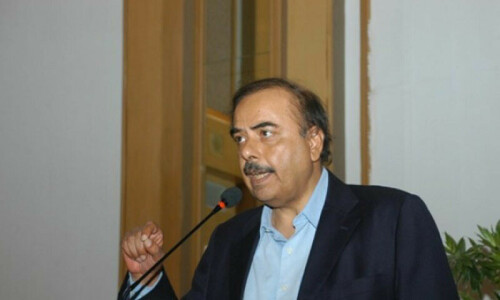
IT fell to the Maulana to save the day. With a constitutional amendment in the balance and powerful individuals repeatedly knocking on his door, Maulana Fazlur Rehman, chief of his own faction of the Jamiat Ulema-i-Islam, broke the deadlock late Sunday when he made it clear that he would not support any extension in the tenure of senior judges.
This is one of the many controversial changes the government reportedly plans to make through its constitutional package, the details of which are still wrapped in mystery.
Given that the JUI-F chief, even with his few votes, could have tipped the scales in favour of or against the amendments, both the government and opposition made all-out efforts to win him over. In the end, his position, stated late on Sunday during a special parliamentary committee’s fourth meeting of the day, forced the government to delay its plans.
As news announcers began breaking the news late last night, signalling a much-needed intermission to a political drama that has kept the nation on edge, it seemed like a fitting conclusion to the International Day of Democracy, which, incidentally, was also being observed yesterday.
Despite all that has transpired over the past few years and the many valid criticisms of Pakistan’s flawed political system, it was heartening to see that the country’s burning political issues can still be settled through old-fashioned dialogue and negotiation. The maulana’s position was underlined by his insistence on major decisions being taken through consultation and negotiation instead of bulldozing them through parliament.
Further, while the government ultimately could not move its desired legislation according to the plan, the opposition offered it an olive branch. It suggested that its proposals be debated more thoroughly and given more time; it even offered conditional support for a suggestion to set up a constitutional court.
As matters stand, there is an opportunity for the chief justice to step away with grace from the controversies surrounding his tenure. While some of his decisions may have sparked debate, Chief Justice Qazi Faez Isa has had an enviable career and earned much honour. The best course of action for him would be to voluntarily step down and ensure that any amendments that affect the judiciary take effect once he retires next month. In doing so, he will not only safeguard the independence of his office but also set a good precedent for future transitions.
Meanwhile, the government must revisit its plans. It should ensure that any proposed changes to the judiciary are subjected to thorough debate and consensus before implementation. Creating a constitutional court is a step worth exploring, but influencing the elevation and transfer of judges is not. Given the importance of these matters, a consultative and transparent process is essential.
Published in Dawn, September 16th, 2024