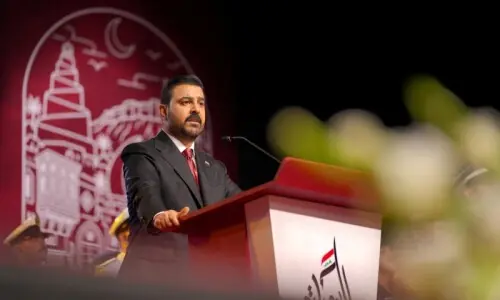
AMERICAN and British troops have once again shipped out of Iraq. On Wednesday, the foreign forces left the Arab country as per an agreement with the Iraqi government in 2024 that called for wrapping up their decade-old mission against the self-styled Islamic State group. While this deployment was requested by the Iraqis, the Americans and their allies had earlier arrived uninvited, invading Iraq in 2003 to topple its strongman Saddam Hussein. That misadventure had left Iraq in ruins, torn apart by sectarian civil war and a terrorist onslaught by IS. On Wednesday, there was great joy on the streets of Baghdad, indicating that many Iraqis were happy to see the foreign forces go home. Iraqi Prime Minister Ali al-Zaidi termed it “a new phase” and declared that Oct 1 would be observed as ‘Sovereignty Day’ every year. Long after IS had been mostly neutralised, the US military presence in Iraq had actually become a liability, with American bases attacked by both Iran and the pro-Tehran Hashd as-Shaabi militias. US President Donald Trump welcomed the latest withdrawal as a “victory”. However, though justifying the need to bring his troops home from Iraq, Mr Trump has gotten stuck in a quagmire because of his war with Iran.
The fact is that American military bases in the Middle East offer only an illusion of security. In reality, they have been a source of instability. Not only have these facilities been used to destabilise and occupy regional states — Afghanistan, Iraq, Syria, etc — they also put targets on the countries that host them. The fantasy of the American security umbrella was very quickly shattered for the Gulf states when Iranian missiles targeted them, as Tehran claimed that the attacks against it were launched from these US bases. Following the example of its departure from Iraq, the US must further reduce its military footprint in the Middle East. It is by no means a global policeman, and its military forays have only resulted in chaos in the region. Instead, the people of the region — the Arabs, Iranians, Turks, and other nations — should be able to work out a mutual security structure based on non-aggression. The age of empire and Cold War calculations is over. Sovereign states of the Middle East can decide their fate for themselves, and do not need powerful external patrons to ‘protect’ them.
Published in Dawn, October 2nd, 2026