Hamas negotiators in Cairo; 50 killed in Israeli strikes on Gaza


CAIRO: Hamas said its negotiators arrived in Cairo on Saturday to hear about the latest round of Gaza ceasefire talks from mediators after the UN reported badly worsening humanitarian conditions, with malnutrition soaring and polio discovered.
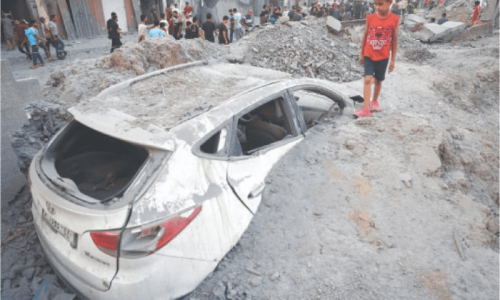
Israeli military strikes across Gaza killed 50 people on Saturday, Palestinian health authorities said. Victims of bombings over the past 48 hours remain lying on roads where fighting continues or trapped under rubble, the authorities said.
Meanwhile, the Israeli military said on Saturday that three reserve were killed in Gaza Strip the previous day.
The officers, two major generals and a lieutenant colonel, were killed in central Gaza, the military said.
Netanyahu insists on keeping troops along the Gaza-Egypt border
The latest deaths bring the military’s losses in Gaza to 338 since it launched a ground offensive in the Palestinian territory on Oct 27.
Months of on-off talks have so far failed to produce a breakthrough to end Israel’s devastating bombardment of Gaza.
Israeli negotiators were in Cairo on Thursday to meet mediators from the United States, which has presented a “bridging proposal” aimed at resolving continued disputes, focused on Israel’s presence in strategic areas of Gaza.
But there was no sign of any breakthrough on key sticking points, including Israel’s insistence that it must retain control of the Philadelphi Corridor, on the border between Gaza and Egypt.
Hamas has accused Israel of going back on issues it had previously agreed to in the talks. The group says the United States is not mediating in good faith.
Netanyahu at odds with negotiators
In Israel, Prime Minister Benjamin Netanyahu has locked horns with ceasefire negotiators over his insistence that Israel will not pull out of the so-called Philadelphi Corridor in the south of the Gaza Strip, a person with knowledge of the talks said.
The Philadelphi Corridor, along the border with Egypt, and the Netzarim Corridor cutting across the middle of the Gaza Strip, have been two of the main sticking points in talks backed by Egypt, Qatar and the United States.
Netanyahu has repeatedly insisted that Israel will not give up control of the Philadelphi Corridor, accusing Hamas of smuggling weapons and fighters across the border with Egypt.
He has also said Israel must maintain checkpoints in the Netzarim Corridor to stop the “movement of Hamas fighters from southern Gaza into the north”.
The person said Netanyahu had agreed to shift one Philadelphi position by a few hundred metres, but would retain overall control of the corridor, despite pressure from members of his own negotiating team for more concessions.
“The prime minister insists that this situation will continue, contrary to pressure from certain elements in the negotiating team who are willing to withdraw from there,” said the person, who has close knowledge of the negotiations.
Israel’s Channel 12 television reported this week that Netanyahu had been bitterly critical of the negotiating team, led by David Barnea, the chief of Mossad intelligence service, for being willing to make too many concessions.
Netanyahu has been under heavy pressure to reach a deal from families of some of the Israeli prisoners who remain in Gaza and many have been strongly critical of the failure to reach a deal, joining critics who have accused him of hindering a deal for his own political purposes.
But with pressure from hardliners in his own cabinet against any concessions, and with opinion polls indicating a pick-up in the disastrous ratings he had after the Hamas raid on Oct 7, the prime minister has said repeatedly he aims for “total victory over Hamas”.
Meanwhile, US Air Force General Charles Q. Brown, chairman of the Joint Chiefs of Staff, began an unannounced visit to the Middle East on Saturday to discuss ways to avoid any new escalation in tensions that could spiral into a broader conflict.
Disease spreading
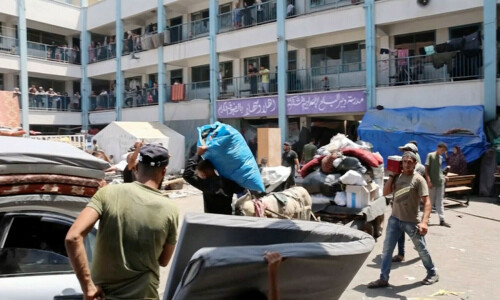
Continuation of the conflict will worsen the plight of Gaza’s 2.3 million people, nearly all of them homeless in tents or shelters among the ruins, with malnutrition rampant and disease spreading, and risk the lives of remaining Israeli prisoners.
The UN humanitarian agency, OCHA, said on Friday that the amount of food aid entering Gaza last month was one of the lowest since October, when Israeli imposed a full siege.
The agency said that last month the number of children with acute malnutrition in northern Gaza was four times higher than in May, while in the more accessible south, where the crisis is less severe, the number more than doubled.
The World Health Organisation said on Friday a 10-month-old baby had been paralysed with polio, the first such case in the territory in 25 years, raising fears of a wider outbreak given the lack of proper sanitation for people living in ruins.
More warfare also risks major new escalations, with Iran still weighing retaliation for the assassination of Hamas leader Ismail Haniyeh on its territory last month.
Fighting between Israel and Hezbollah since Oct 7 has ramped up recently, including with Israeli strikes across southern Lebanon and into the Bekaa, and with more Hezbollah rocket fire into northern Israel.
Published in Dawn, August 25th, 2024