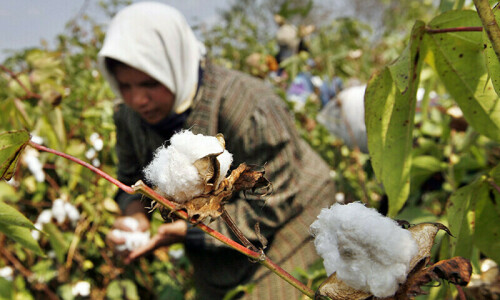
LAHORE: Disillusioned by low prices for their crop and the lack of government support, cotton growers have shifted to alternative crops, resulting in lower cultivation area and yield.
The difference in cultivation data from last year and this year’s Kharif season is the most stark in ‘Punjab’s cotton valley’ comprising Bahawalpur, Multan and Dera Ghazi Khan divisions.
Data from the Punjab Crop Reporting Service (CRS) show that white lint could not achieve its sowing target of four million acres and fell short by 19 per cent to 3.22m acres in the Kharif season of 2024.
The total cultivation area was over 32pc less than last season’s 4.15m acres. The decline in the cultivation area of cotton this season has come on the back of a bumper crop during July 2023 to March 2024.
Data shows cultivation area shrinking from 4.15m acres last year to 3.22m this time
According to the provisional data in Pakistan Economic Survey released earlier this week, cotton’s production more than doubled from 4.91m bales in the last fiscal year to 10.22m bales.
The total cultivation area also increased for the second consecutive year in the first nine months of FY 2024 after declining for three years between 2019 and 2022.
In 2023/24, the crop was cultivated on 2.42m hectares, up by 13.1 per cent from 2.14m hectares in 2022/23, as per the survey data.
Cotton’s loss is other crops’ gain
This season’s declining cultivation area is expected to impact the overall crop yield which will imperil the textile sector depending on cotton as the main raw material.
The sector already witnessed a massive contraction of 8.3pc during July-March of 2024 after a 16pc dip in the same period last year, according to the Pakistan Economic Survey.
Cotton growers are now opting for more profitable crops whose input costs aren’t as high as the white lint.
In Bahawalpur division, the core cotton area in Punjab, growers are opting for sesame and rice.
The overall land area of sesame increased from over 0.9m acres last year to 1.7m acres this season, a jump of 82.9pc.
The overall cultivation area of sesame also increased by over 168pc in the division from 57,756 acres last year to 154,974 acres this season.
Likewise, the plantation of rice nurseries has also increased in the province this season, with estimates putting the total coverage area at 6.73m acres against the target of 5m acres.
In south Punjab, the plantation is up 13pc from 81,144 to 93,154 marlas, enough to sow paddy on 1.37m acres of land against the target of 0.91m acres and last year’s 1.17m acres.
CRS DG Dr Abdul Qayyum said the production cost of seed cotton (phutti) has gone up from Rs116,930 per acre at the market gate last season to 146,413 this year. In accordance with the rising cost of production, CRS enhanced its suggested price of seed cotton from Rs8,858 last season to Rs9,243 per 40kg.
The government had fixed Rs8,500 per 40kg intervention price of seed cotton last year, promising the growers that they would get the minimum price for their crop.
But, the government “failed to keep its promise” and did not mobilise the Trading Corporation of Pakistan to buy seed cotton and stabilise the market, said Muhammad Azeem, a cotton grower from Rahim Yar Khan district.
He regretted that as a result of this inaction, prices fell even below Rs7,000 per 40kg.
“In view of the poor cotton rate last season, many growers like me have already decided not to sow the crop this year.”
He added that the Punjab government’s decision of not buying wheat from farmers further made cotton growers apprehensive who feared a similar treatment with their produce.“[T]he exclusion of a major player like the Punjab Food Department crashed the market causing huge losses to the wheat growers, who were left with no choice but to abandon the risky cotton crop which also requires heavy resources for multiple sprays of pesticides and weedicides,“ Mr Azeem added.
Published in Dawn, June 17th, 2024