South Africa gears up for ‘most unpredictable’ vote



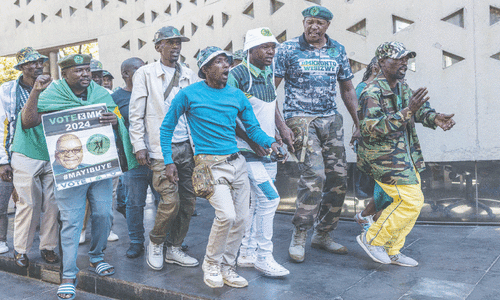
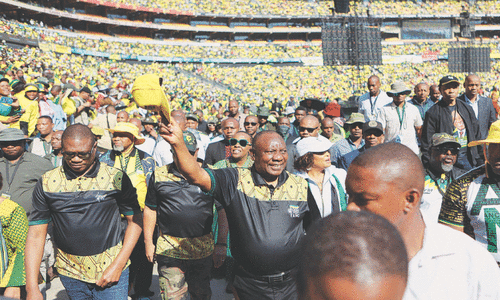
JOHANNESBURG: South Africans on Tuesday braced for an ‘evenly matched’ general election, which may loosen the ruling ANC’s 30-year grip on power. Numerous voters now seem to be fed up with unemployment, crime and corruption.
For the second day running, 1.6 million “special voters” including the elderly, essential workers, police and prisoners, were permitted to cast early ballots. The rest of South Africa’s 27-million-strong registered electorate will be called forth on Wednesday, to elect the provincial legislatures and a new national parliament. The national parliament will then hand-pick the countries new president.
For the first time since the advent of democracy, the African National Congress risks losing its outright majority. The ANC may be forced to negotiate, to form a coalition government. “This is certainly South Africa’s most unpredictable election since 1994” says a political analyst, Daniel Silke.
“It reflects the broad-based economic decline that the country has been languishing under now for the better part of the last decade or so.” Under the leadership of the late Nelson Mandela, the ANC secured freedom for black South Africans (after decades of apartheid rule). The ANC then helped build a strong democracy and lifted millions out of poverty, by creating a broad-based ‘social welfare system’.
However, many in the country now blame the ANC for overseeing massive grafs and mismanaging the economy. “I will not vote for ANC but I don’t know who I will vote for” said Nomsa Cele, a 55-year-old hawker. Nomsa sells hats and jewellery on the quiet Durban beachfront. Durban is the largest city in the battleground province of ‘KwaZulu-Natal’, whose streets are plastered with electoral posters.
In the bustling streets of ‘Umlazi’ township (one of the biggest in KwaZulu-Natal), rival tents for the ANC and the radical-left opposition ‘Economic Freedom Fighters’ (EFF) were pitched outside the Umlazi Commercial High School.
Busisiwe Mthethwa told reporters that her ballot was ‘secret’ but stated with a ‘slight smile’ that she would vote for the “red party” (implying she was leaning towards the EFF).
The 62-year-old says she did not cast her vote in the 2019 polls because “she had lost hope in the ruling party’s corruption tactics”. She believes “it’s now time to make my vote count and kick them out.”
An ‘Afrobarometer’ survey published last week portrays that unemployment (currently at 32.9 percent), rolling blackouts, corruption and poverty were the ‘most urgent problems’ that South Africans wish to be addressed.
‘A weaker party’
The Incumbent President, Cyril Ramaphosa, is seeking a second term and defended his record in a speech to the nation on Sunday. Ramaphosa cited progress in fighting graft and mending gaps in electricity production, amongst other successes.
“We have placed South Africa on a new trajectory of recovery and laid a strong foundation for future growth” the 71-year-old said. “We cannot afford to turn back. There is more work to be done.”
Published in Dawn, May 29th, 2024