US ‘will not accept’ flood of below-cost Chinese goods: Yellen


The United States “will not accept” a situation where underpriced Chinese goods flood the global market, battering industries elsewhere, US Treasury Secretary Janet Yellen said on Monday as she wrapped up high-level talks in China.
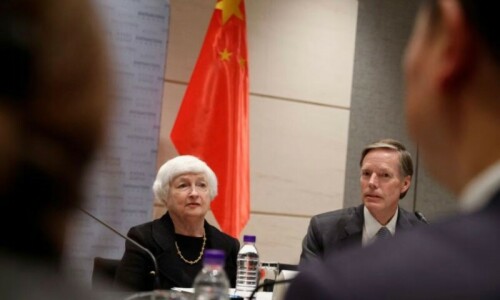
Yellen repeatedly warned about the risks of China’s excess industrial capacity during four-day talks with officials and business leaders in the southern city of Guangzhou and capital Beijing.
Washington’s concern is that as Chinese government support creates more production capacity than global markets can absorb, a surge of cheap exports in sectors such as solar and electric vehicles could stifle the growth of these industries elsewhere.
Yellen said on Monday that massive Chinese government support had led to a flood of below-cost steel into the global market over a decade ago, which “decimated industries across the world and in the United States”.
“I’ve made clear that President Biden and I will not accept that reality again,” she told a news conference, adding that US allies and partners share similar concerns.
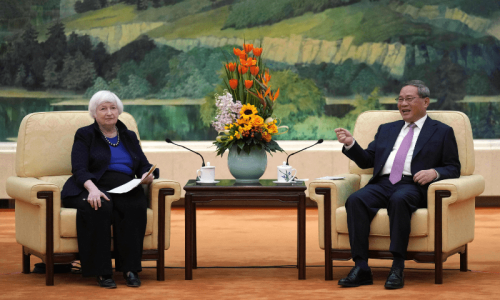
Besides tackling the issue with her counterpart Vice Premier He Lifeng over around 11 hours of talks, she raised it with Premier Li Qiang as well — moves that Washington hopes will bring these concerns to the highest levels of Chinese policymaking.
Yellen said she was especially worried about “imbalances” such as China’s weak household consumption and business overinvestment, “aggravated by large-scale government support in specific industrial sectors”.
But Beijing has pushed back, with China’s Commerce Minister Wang Wentao calling overcapacity fears “groundless”, according to state media.
This comes even as bilateral ties have stabilised with both sides willing to cooperate on issues including climate change, debt restructuring, and anti-money laundering.
The two countries have also agreed to open channels for further talks on excess capacity.
But Li earlier told Yellen that Washington should view the matter of production capacity “objectively” and from a “market-oriented” perspective, the state-run Xinhua news agency said.
Yellen noted that excess capacity concerns will not be addressed in a week or month, but stressed that doing so would be positive for China’s long-term productivity and growth.
‘No surprises’
Yellen said she also had “difficult conversations about national security”, warning Chinese officials of the consequences of supporting Russia’s military procurement and using economic tools over national security concerns.
In particular, she said Washington was committed to having “no surprises” in the use of such tools.
She said the United States has laid out its principles and policymaking process.
But she added: “We would welcome transparency from [China] on its national security actions and greater clarity on where it sees the line between national security and economic issues.” Yun Sun, senior fellow at think tank the Stimson Center, said that overall, Yellen’s ability to meet with senior Chinese officials to convey US concerns and “probe” China’s reactions is a positive development.
But she cautioned that China is unlikely to give up or change its current growth model and areas of focus because of the United States, unless there are significant consequences, given its economy is “not in the best shape”.
But both sides’ agreement to cooperate in technical areas such as tackling money laundering would be helpful to boost confidence in their relations, Sun said.
Among areas of cooperation, Yellen said she has seen progress in recent months over specific debt cases such as Zambia’s.