PESHAWAR: The Khyber Pakhtunkhwa government has planned to make the Institute of Liver Transplant in the provincial capital operational in the next three months.
It has also decided that the institute being put up at the Institute of Kidney Diseases of the Hayatabad Medical Complex will carry out 15 free medical procedures every month to replace diseased livers of patients with healthy ones from donors.
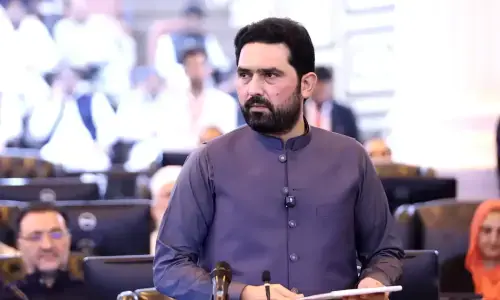
“We [the government] are going to operationalise the Institute of Liver Transplant, the first of its kind in the province, for hepatic transplantation. It’ll cater for patients from Peshawar region as well as Hazara, Malakand and southern areas of our province,” the focal person for the chief minister on health Dr Amjad Ali Khan told Dawn.
He said the provincial government had already allocated more than Rs200m for the institute, which would procure goods directly from foreign manufacturers,” he said.
15 free medical procedures planned every month, says CM’s focal person
Dr Amjad, a PTI-backed MNA from Swat district, said he was tasked by Chief Minister Ali Amin Khan Gandapur with overseeing health projects in the province, considering his healthcare expertise.
“I’ll ensure the projects are completed on time and the taxpayers’ money is utilised to people’s benefit,” he said.
The focal person said currently, the province didn’t have any institute for liver transplants, prompting well-off residents to go to other provinces or abroad for hepatic transplantation, while the poor ultimately died because they were unable to afford the high cost of the procedure.
He said after the institute became functional, patients from districts other than Peshawar, too, would avail themselves of the free transplant facility there.
“We are in contact with the relevant departments and doctors to ensure that the institute becomes operational without trouble, as the chief minister wants to see people with damaged livers live a normal life in line with the PTI’s agenda of universal health coverage,” he said.
Dr Amjad said the government was also committed to the early establishment of the Institute of Bone Marrow Transplant at the Regional Blood Centre of the HMC.
“We’ve already pledged Rs300 million for the institute. There is no cure for blood issues, so patients have to rely on blood donations for survival,” he said, adding that bone marrow transplantation will give a new lease of life to the patients by ending their dependency on blood transfusion.
The focal person said hundreds of people suffering from thalaessemia underwent cashless bone marrow transplants at the institute to stay alive and work as normal people.
He said work had already been initiated on the architectural design of the institute, and an expert from his hometown, Swat, had volunteered his services for it.
“It will be an institute of international standard to be linked with national and international institutes to offer the latest health services,” he said.
Dr Amjad said the proposed Institute of Neurosciences and Orthopaedic Centre of Excellence was not only meant to provide services to the people, but it would also impart the latest knowledge and techniques to doctors, nurses, and paramedics in those specialties and spread services to other regions in the near future.
He added that all those institutes would be linked with three regions, including Hazara, Malakand, and the southern belt, whose patients would be referred to Peshawar institutes for specialised services.
“People will get services like hip and knee replacement free of charge,” he said, adding that expenses for these procedures are unaffordable for the common man.
Dr Amjad said the government was supporting those initiatives to improve patient care, as currently there was no treatment available for liver cirrhosis and thalaessemia, whose only solution was transplantation.
He said patients would get all investigations and medication free of charge.
“We [the government] will provide all required budgetary allocations to these institutes,” he said.
Published in Dawn, April 5th, 2024