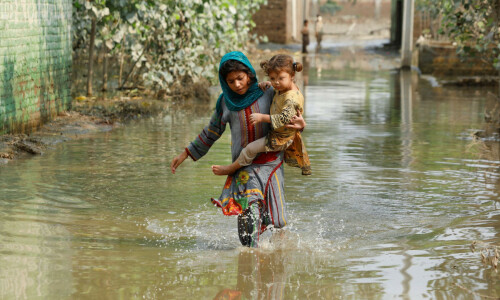
WASHINGTON: The 2022 floods in Pakistan demonstrate how the changing global climate can destabilise a strategically important region, warns a new US State Department report on emerging security threats.
The March 2024 report on “New Security Challenges,” released in Washington this week, delves into the ongoing conflict in Gaza, cautioning that the mere absence of war in a region should not be mistaken for the existence of peace.
Prepared by the State Department’s International Security Advisory Board, the report identifies climate change and resource scarcity as the most pressing challenges confronting the global community.
The other key challenges identified in this report are the emergence and spread of human, animal, and plant diseases, and the exploitation of identity-based bias, discrimination, and violence by state and non-state actors.
“From the tragic floods in Pakistan in 2022 to the prolonged drought across parts of Africa and Latin America, strategic regions are increasingly destabilised by compound climate effects,” the report warns.
Other factors such as “state fragility, weak governance, conflict over identity and inequality, and poor infrastructure and social resilience” make the situation more alarming, the report adds.
Nuclear concerns
The report also mentions nuclear cooperation between Pakistan and China, noting that in 2023, China announced plans to build a new nuclear plant in Pakistan. “Though China and Pakistan have had a long-term strategic relationship, Pakistan is not a party to the NPT and possesses nuclear weapons, raising continuing concerns,” the report adds.
Referring to the Gaza situation, the report notes that the development “led to a new war in the Middle East and provides a stark example of how previous assessments of the absence of active conflict did not mean the presence of peace and human security.”
The report also notes that these traditional military threats are occurring alongside a set of evolving security challenges. “Of these, climate change is the most significant and existential threat that has emerged, but it is not the only challenge,” the report mentions.
The report also states that in the Middle East, the United States and its European partners are continuing efforts to “prevent Iran from nuclear weapons development” while exploring nuclear cooperation with Saudi Arabia.
Re-emphasising the threat posed by climate change, the report warns that temperatures across the globe continue to rise, despite efforts to mitigate carbon emissions and decarbonise energy production.
Published in Dawn, April 1st, 2024