Pakistan’s ‘historic’ lunar mission to be launched on Friday aboard China lunar probe



The Institute of Space Technology on Tuesday said Pakistan’s “historic” lunar mission iCube-Q will be launched on May 3 at 12:50pm on board China’s Chang’e 6 lunar probe from Hainan, China.
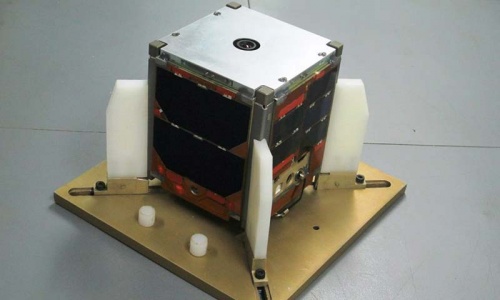
According to the Institute of Space Technology (IST), the satellite ICUBE-Q has been designed and developed by IST in collaboration with China’s Shanghai University SJTU and Pakistan’s national space agency Suparco.
ICUBE-Q orbiter carries two optical cameras to image the lunar surface.
Following successful qualification and testing, iCube-Q has now been integrated with the Chang’e 6 mission.
Chang’e 6 is the sixth in a series of China’s lunar exploration missions.
The launch activity will be telecast live on the IST website and IST social media platforms.
China’s lunar mission will touch down on the moon’s far side to collect samples from the surface and return to Earth for research.
The mission holds significance for Pakistan as it will also take a CubeSat Satellite iCube-Q, developed by IST.
CubeSats are miniature satellites typically characterised by their small size and standardised design.
They are constructed in a cubic shape, consisting of modular components that adhere to specific size constraints.
These satellites often weigh no more than a few kilogrammes and were deployed in space for various purposes.
The primary purpose of CubeSats was to facilitate scientific research, technology development, and educational initiatives in space exploration.
These satellites were utilised for a wide range of missions, including Earth observations, remote sensing, atmospheric research, communications, astronomy and technology demonstration.
Due to their compact size and relatively low cost compared to traditional satellites, CubeSats offered opportunities for universities, research institutions and commercial entities to participate in space missions and gather valuable data for scientific advancement and innovation.
They serve as platforms for testing new technologies and concepts, enabling access to space for a broader range of users and promoting collaboration within the space community.
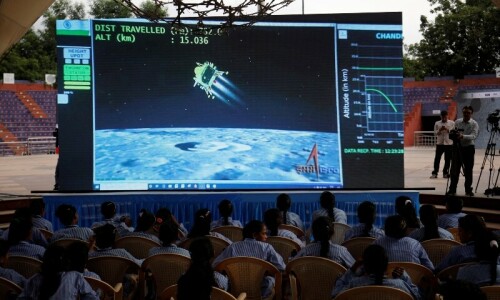
Last year in August, India became the first nation to land a craft near the Moon’s south pole, a historic triumph for its ambitious, cut-price space programme.