WASHINGTON: As the State Department reiterated that it did not want Afghanistan to be a safe haven for terrorism, experts based in the US see very little chance of a full-blown conflict between the two neighbours following Monday’s air strikes.
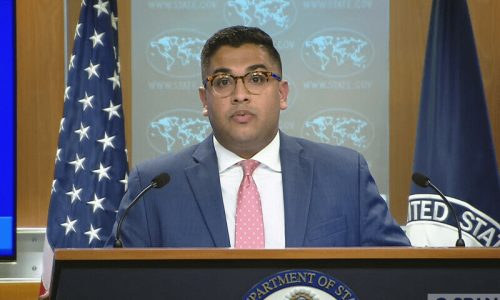
During a press briefing on Monday, Vedant Patel underlined that the US doesn’t want Afghanistan to become a safe haven for terrorism. “When it comes to counterterrorism cooperation with our Pakistani partners, it’s something we engage with them quite regularly, including other bilateral cooperation with them as well,” he said.
However, observers are apprehensive that even simmering tensions will aggravate the plight of Afghan refugees, who are caught between a rock and hard place, so to speak.
According to Roya Rahmani, who was the first woman to serve as Kabul’s ambassador to Washington, the cross-border terror attacks on Pakistan on March 16 and the subsequent retaliation by Islamabad have exposed the discord between Pakistani authorities and the Taliban leadership.
US-based experts rule out any possibility of further escalation
In a blog post for the Atlantic Council, Ms Rahmani, now a senior adviser at the council’s South Asia Centre in Washington, contends: “These conflicts underscore the fact that, despite expectations, the Taliban have not been entirely under Pakistan’s control”. “They also highlight the Taliban’s inability to influence the TTP’s activities in Pakistan,” she added.
She emphasised that the retaliatory airstrikes conducted by Pakistan within Afghanistan “serve as a political assertion, showcasing Pakistan’s commitment to protecting its military and people”.
While acknowledging potential casualties, Ms Rahmani stated: “The likelihood of a full-blown conflict remains low. The Afghan Taliban, aware of the risks, are hesitant to engage in prolonged military confrontation with Pakistan, given its familial ties, financial interests, and support base in Pakistan.”
“Internal divisions within the Afghan Taliban further complicate a unified response to Pakistan’s actions,” she added.
Nilofar Sakhi, a lecturer at George Washington University’s Elliott School of International Affairs, underlined the inherent threat posed by ties between the Taliban and the TTP to the stability of Pakistan.
Pakistan’s determination
She contended that due to the Afghan Taliban’s connections with transnational terror and extremist groups, tensions between Islamabad and Kabul are inevitable from a security standpoint.
Ms Sakhi highlighted the intricate relationship between the Afghan Taliban and the Pakistani establishment, which further complicates matters. She argued: “Despite the Afghan Taliban’s purported disapproval of attacks and instability in Pakistan, its affiliation with the TTP and shared ideology pose a threat to the stability of the Pakistan establishment, further deteriorating bilateral relations.”
Muhammad Faisal, a PhD candidate in international relations at the University of Technology Sydney, analysed Pakistan’s response through the lens of a strategic intent.
“Pakistan’s challenge is to telegraph deterrence through sustained air strikes rather than a one-off retaliatory strike to send a message”. He predicted that tensions between Islamabad and Kabul are likely to escalate further, particularly with the commencement of the second phase of repatriation of Afghan refugees after Ramazan.
But Uzair Younus, a senior fellow at the Atlantic Council, asserted that Pakistan had demonstrated its capacity and determination to counter cross-border terror attacks by targeting sanctuaries in Afghanistan.
“While calm may be restored in the coming days and weeks ahead, the newly elected government and the military leadership in Pakistan seem to have run out of patience with the Afghan Taliban,” Mr Younus observed.
Published in Dawn, March 20th, 2024