ISLAMABAD: As the Supreme Judicial Council (SJC) on Friday concluded proceedings on a reference against retired Supreme Court judge Sayyed Mazahar Ali Akbar Naqvi, the petitioners in the Afiya Shehrbano Zia case called for reform in the council’s procedure.
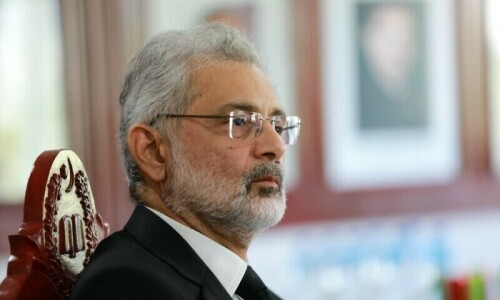
During proceedings on Friday, Chief Justice of Pakistan Qazi Faez Isa pointed out that Justice Naqvi had written a letter to the council, saying he refused to appear before it.
CJP Isa remarked that the SJC had repeatedly invited the accused judge to cross-examine witnesses in open proceedings, but the latter never availed the opportunity for his defence.
On Thursday, a leading developer, Zahid Rafiq, had conceded before the SJC that he had arranged £5,000 for the daughter of Justice Mazahar Naqvi.
Separately, explaining their reasons for seeking an inquiry into alleged misconduct by judges of the superior courts, even after their retirement, the petitioners reiterated that their complaint was part of a campaign for civilian supremacy, and against state excesses.
The petitioners said they believed the procedure of the SJC must be reformed and that accountability is important for judicial independence, but selectivity and singling out certain judges by the state through its proxies, using references and proceedings against them, is an abuse of power and process, not a form of impartial and unbiased accountability.
They said a reference was filed against former chief justice Saqib Nisar in 2018 under Article 209 of the Constitution for misconduct, breach of judges’ code of conduct and excesses that infringed on the principle of the separation of state powers.
That judicial reference was signed by 98 citizens, many of whom were prominent in the MRD and the lawyers’ movement for the restoration of independent judiciary.
“This was a prescient challenge by these citizens for judicial correctives, considering the confusion, coercion, unresolved powers and excesses that Pakistan’s senior judiciary has incrementally unleashed and itself been subjected to, particularly in the post-Saqib Nisar era,” they said.
Published in Dawn, March 2nd, 2024