ON Friday night, PML-N leader Khawaja Saad Rafique took to X to highlight the challenges facing politicians in forging a new government in Islamabad in the absence of a clear mandate for any single party.
“No party has [an] absolute majority in the National Assembly,” he reminded other stakeholders, largely the PPP. Therefore, he said, “the formation of government is the joint responsibility of all the parties in the parliament, [and] not just PML-N”. Alternatively, he suggested that PTI-backed independent members form a government with PPP support.
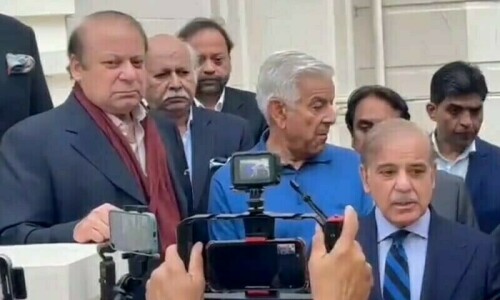
Although it is unclear whether Mr Rafique’s words reflect his own or his party’s position, the gist of his message posted after a party huddle reportedly chaired by Nawaz Sharif is that governing the country would be akin to wearing a crown of thorns amid chaotic political and economic conditions, and that his party had no desire to claim it.
He is not the only PML-N politician to hint at stepping back from the party’s initial stance of entering into a coalition with the PPP and others as spelled out by Mr Sharif in his post-election speech after it became clear that the N-League hadn’t won enough seats to make a government on its own.
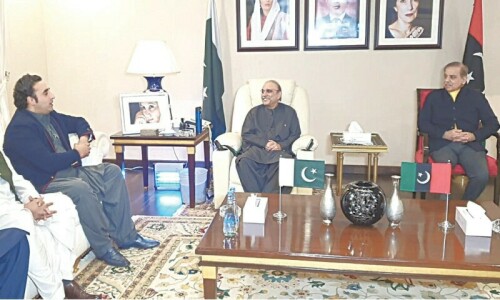
Many are understood to have advised their leader against forming a minority government at the centre, especially after Bilawal Bhutto-Zardari announced support for a PML-N-led set-up in exchange for the top constitutional offices and a PPP government in Balochistan.
It may be a unique experience for Pakistan but parliamentary democracies everywhere have seen minority governments supported by other parties function quite well. In India, the Congress supported the minority Janata Dal government in the 1990s.
If the PPP is demanding too much, PML-N can negotiate a deal. Give-and-take is essential as the PPP also has much to lose if the system is derailed. Even a rowdy PTI would not want to rock the apple cart of democracy once it has made its point on rigging. Governing a politically and economically distraught nation would indeed be tough for the PML-N without sufficient numerical strength in parliament.
Divergent political interests might occasionally thwart or slow down legislative and economic reform. But should these hold back the three-time PM from accepting the challenge because of fear of the unknown, or losing the support of the PPP and others at some point? That hardly makes sense.
The people have given a split verdict. Now it is time for all political stakeholders to respect it. The biggest responsibility rests with the PML-N. Mr Sharif should not only put away his fears to form a minority government, he must also realise that the nation has deep wounds to heal. A politician of his stature can overcome hurdles. It is a challenge he should accept.
Published in Dawn, February 19th, 2024