KARACHI: When she was seven years old, Saina* one day went to market along with her grandfather and at a particular moment when his attention was distracted, she was abducted and not heard from again for several years.
“I still remember she was wearing a yellow frock [on the day the unfortunate incident took place]. For the next two years, we kept looking for her and saw her in every child. Her grandfather could not sleep a single night since she went missing. The night he died, he was holding her doll in his hands,” her mother, Kainat Bibi, told Dawn.
The family eventually found Saina working as a maid in the town of Sadiqabad in Punjab.
Her body was covered in bruises. It was evident that she had gone through physical abuse, and possibly much worse.
“The monsters robbed her of her childhood. She still struggles to sleep at night,” Attaullah, Saina’s father, told Dawn.
Fearful of learning even more horrible details, the family chose not to subject the girl to a medical check-up
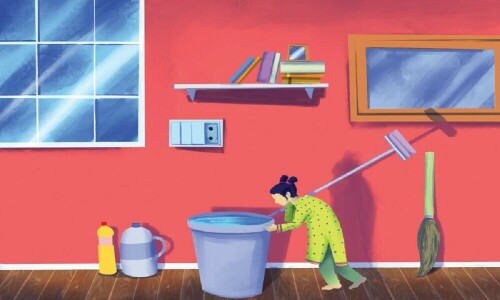
Saina was compelled to engage in child labour at the residence of a powerful individual. She narrated how she was obligated to undertake household tasks, including cleaning and doing the dishes; she spent nights in a servant quarter.
Early each morning, she was compelled to commence her duties, which extended far beyond age-appropriate responsibilities.
“I want to play with a doll-house, and go pray every day with my nana like I used to, but since he is no more, I pray for him every day,” the nine-year-old says.
Disturbing realities
Unfortunately, hers is not an isolated case. Estimates from Unicef and other organisations working for children indicate that approximately 3.3 million children in Pakistan are ensnared in child labour — a crisis exacerbated by the Covid-19 pandemic that pushed numerous families below the poverty line.
In 2022, the Sahil Foundation, an NGO, recorded a total of 4,253 cases related to various forms of child abuse, including abduction, sexual abuse, and forced marriages. Of these, 2,123 cases involved child sexual abuse, with the most vulnerable age group identified as 6-15 years. In the first half of 2023, the reported cases of such cases was 2,227.
Data from the National Commission on the Rights of the Child (NCRC) underscores that among children compelled into child labour, 69.4 per cent are engaged in the agricultural sector, while 19.7pc work in various services, and the remaining 10.9pc are employed in industries.
These statistics reveal a distressing interplay between economic hardships, child labour, and various forms of abuse experienced by vulnerable children in Pakistan.
Hasib Ullah* was forcibly taken away from his home in Khyber Pakhtunkhwa and transported to Balochistan, where he fell victim to the harrowing practice of being sold into carpet slavery. After three agonising years, however, his uncle managed to locate him and Hasib was discreetly reunited with his family.
As part of his responsibilities, Hasib was made to sew, weave, and clean carpets at a factory. When he couldn’t promptly complete a given task, he faced punishment in the form of beatings, his mother recounted, who learned of the harrowing experiences from her son.
“It’s been six months since he came back, yet he has been quiet most of the time. He does not talk, smile or go out to play, and he does not recognise his friends. We have tried every possible way to make him speak, but the only time we get to hear his voice is when he screams in his dreams,” his mother says.
Hasib endured physical torture while being made to weave carpets using his bare hands. Today, months after the ordeal, his fingers bear the lasting imprints of the arduous labour he was forced to carry out.
Despite persistent bleeding from his wounds, his mother attests that Hasib, gripped by a profound numbness, does not shed tears in response to pain; he simply sits there in silent suffering.
“My child was so full of life. He was so good at maths, he would solve sums in minutes, and now he has been numb for months. My heart dies a little every day, but then I think of all those mothers who failed to find their children, at least I was able to find mine,” she says.
“Addressing the complex issues of child labour and sexual abuse requires a multifaceted approach with the active involvement of communities, civil society, governments, and media,” said former senator Ayesha Raza.
“While several laws exist to curb child labour, there’s a critical need for a comprehensive law specifically criminalising child domestic labour. The NCRC’s proposed amendment to the Pakistan Penal Code aims to make child domestic labour a non-bailable and non-compoundable offence, holding employers and caregivers accountable,” she added.
*Names have been changed to protect the identities of victims
Published in Dawn, November 21st, 2023