LAHORE: The caretaker Punjab government has announced a mask mandate for ten districts because of the worst air quality due to smog.
The decision came as the provincial government attempts to implement measures to combat smog, which worsens every year with the onset of winter.
Citizens in 10 districts of Lahore and Gujranwala divisions must wear masks when stepping out for one week — from Nov 20 (Monday) to 26 (Sunday).
The restriction has been imposed in Lahore, Nankana Sahib, Kasur, Sheikhupura, Gujranwala, Gujrat, Sialkot, Narowal, Hafizabad, and Mandi Bahauddin, according to a notification issued by the Primary and Secondary Healthcare Department Secretary Ali Jan Khan.
Air quality in Karachi, Lahore at ‘hazardous’ levels on Sunday
“High levels of air quality due to smog pose a serious and imminent threat to public health in all age groups. Hence, it is mandatory to take all possible safety measures for prevention and control of airborne diseases in the province of Punjab,” the notification added.
Sharing a copy of the notification on X, formerly Twitter, Punjab caretaker Chief Minister Mohsin Naqvi said the decision was taken in response to the deteriorating air quality in Punjab.
“Prioritising health is our collective responsibility. Please adhere to the guidelines for a safer community.”
Dr Jamal Nasir, the caretaker minister for primary and secondary healthcare, said that protecting the health of citizens is the government’s top priority.
We are utilising all possible resources to combat pollution and overcome smog, he said, advising citizens to strictly abide by the mask mandate to avoid allergies and diseases due to smog.
Hazardous air quality
On Sunday, the two biggest cities, Karachi and Lahore, topped the air quality index (AQI) and became the most polluted cities.
In Lahore, the AQI was around 406 at 9am with PM 2.5 concentration at 358 — over 50 times more than the WHO air quality guideline. By 8pm, the particulate matter concentration had reduced to a “very unhealthy” level of 241.5.
According to IQAir, a website tracking air quality in cities worldwide, the AQI for Karachi was 302 (hazardous) at 8pm.
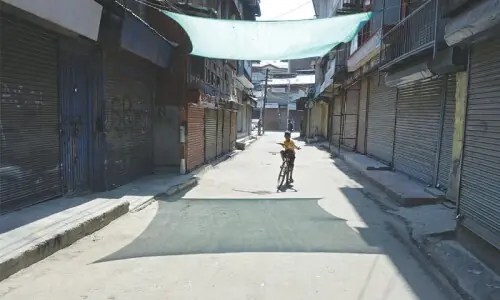
On Saturday, the caretaker Punjab government imposed a ‘smart lockdown’ in several major districts, including Lahore. All schools, offices, markets and entertainment venues were closed, and people were advised to limit their movement and avoid leaving houses except for unavoidable needs.
The lockdown was also aimed at restricting the spread of conjunctivitis, also known as Pink Eye, which was rapidly spreading due to high levels of air pollution.
The restrictions were lifted in Lahore on Sunday, and markets and restaurants were allowed to reopen.
Dense smog and hazardous air quality have become a severe health crisis in Punjab over the past few years. The causes for recurring smog are multifaceted, according to officials and experts.
The smoke emitted from vehicles and emissions from industries and brick kilns are the major contributors.
The burning of crop residue and general waste, dust from construction sites and reduced tree cover due to rapid urbanisation also contribute to the hazardous air quality.
Every year, the government attempts to tackle the issue by taking administrative measures like a ban on residue and water burning, closure of some brick kilns and factories and reduced presence of cars and other vehicles.
However, these measures have proved inadequate to curb the smog, leaving citizens anguished and frustrated.
According to experts, the solution lies in increasing renewable energy resources to cut fossil fuels and coal dependency.
They have also called for implementing stricter emission standards and regulations for vehicles and industries and ensuring compliance and accountability.
More public transportation projects and building infrastructure for alternate modes of commuting like cycling and walking can also help reduce the number of privately owned vehicles on roads.
Published in Dawn, November 20th, 2023