ISLAMABAD: Short-term inflation hit a new high for the fifth week in a row as the retail price of petroleum products soared, according to official data released on Friday.
Measured by the Sensitive Price Index (SPI), short-term inflation saw a year-on-year increase of 38.28 per cent for the week ending on Oct 12. This is the second-highest increase in five weeks.
It was primarily driven by a surge in the retail prices of electricity, petroleum products, LPG and essential food items. This increase is likely to have a domino effect on various sectors, particularly transportation.
Last week, the caretaker government marginally lowered the prices of petroleum products following three consecutive fortnights of rate increases triggering a hike in transport fares. The cost of moving goods has also increased due to higher fuel prices.
Surge comes on back of high prices of electricity, petrol, LPG and essential food items
Analysts anticipate a decrease in petroleum prices in the review set for the early next week. Despite this, transportation costs persistently remain unaffected by any reductions in petroleum prices due to the absence of a regulatory system.
Short-term inflation rose 0.3pc from the preceding week, data showed. Of the 51 items in the SPI basket, prices of 17 goods soared while those of 17 dropped. The number of items whose prices remained unchanged compared to the previous week was also 17.
During the week under review, the items whose prices increased the most over the same week a year ago were electricity charges for the first quintile (136.89pc), gas charges for the first quintile (108.38pc), cigarettes (95.36pc), rice basmati broken (86.21pc), chilies powder (84.84pc), wheat flour (79.28pc), rice Irri-6/9 (75.98pc), sugar (71.87pc), gur (65.09pc), salt powdered (60.78pc), Lipton tea (58.75pc) and gents sponge chappal (58.05pc).
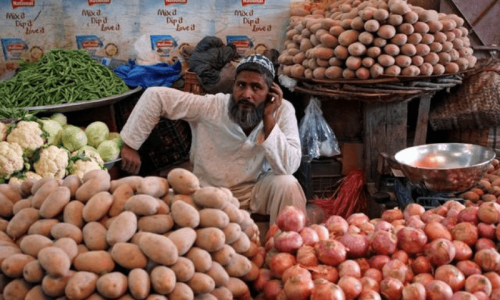
The biggest increases week-on-week were seen in the prices of tomatoes (6.28pc), eggs (3.48pc), salt powdered (2.75pc), cooked beef (1.06pc), garlic (1.04pc), tea prepared (0.73pc), beef (0.39pc), potatoes (0.35pc), electricity charges for the first quintile (8.59pc), energy sever (0.55pc), shirting (0.47pc) and LPG (0.31pc).
In May, the SPI stayed above 45pc for three weeks after hitting an all-time high at 48.35pc on May 4.
The rupee depreciation, rising petrol prices, sales tax and electricity bills are among the key contributors to this inflationary trend. According to the latest IMF forecast, the average Consumer Price Index (CPI) for the current fiscal year is projected to be 25.9pc versus the previous year’s 29.6pc.
Meanwhile, a decrease was also observed on a week-on-week basis in the prices of sugar (4.47pc), pulse gram (2.75pc), bananas (2.47pc), pulse moong (2.44pc), gur (1.93pc), chicken (1.69pc), rice Irri-6/9 (1.46pc) and pulse masoor (1.26pc).
Published in Dawn, October 14th, 2023