ARE the lines blurring between the responsibilities of a caretaker government and the mandate of elected assemblies?
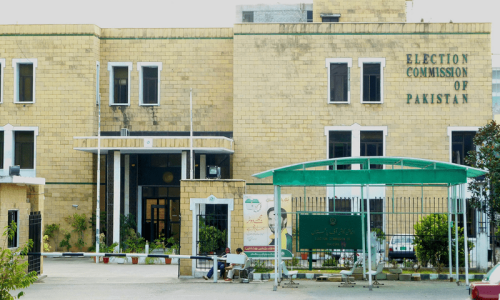
In August, the ECP banned the granting of NOCs to new housing societies in Punjab. It also reminded the interim chief minister that such policies exceed the authority of a caretaker set-up. But, two months later, the KP caretakers seem to have fallen out of line.
On Wednesday, the provincial interim government approved amendments to the Muslim Family Laws Ordinance, 1961, to include the “oath of finality of Prophethood [PBUH] in the marriage registration form”.
The Lahore High Court issued directives for revisions in the nikah form during the hearing of a writ petition. Subsequently, a joint resolution by the provincial assembly solicited the insertion of the “Khatm-i-Nabuwat oath” in the nikahnama.
Caretaker governments are watched with scepticism so even a slight slip-up ignites flak. Their prime function is to hold the fort; from the dissolution of the assemblies, through the run-up to free and fair elections, and ending with the swearing in of a new, elected dispensation.
They should also execute routine governance and ensure smooth, impartial continuity in matters of the state. For this reason, interim systems impinge on the authority of an elected legislature when they engage with long-term issues.
Instead, the relevant authorities would do well to prioritise women-centric progress.
Take a diagnostic study of Punjab, which found that a resounding 60pc of nikahnamas, registered from 2016 to 2022, were incomplete, or that the bride’s CNIC number was absent in 48pc of marriage contracts, 75pc of girls were 16 to 18 years old and the alimony section was blank in 39pc. Admittedly, this paints a grisly portrait for future generations.
Therefore, the time is now to steer away from policymaking and move towards emancipation and empowerment of women with a greater understanding and participation in the nikahnama so that their socioeconomic rights are unequivocally settled.
Published in Dawn, October 13th, 2023