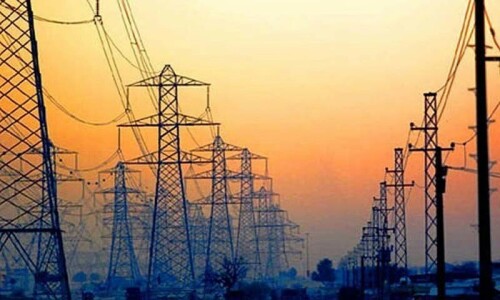
ISLAMABAD: Power sector circular debt continues to grow despite all the repeated tariff increases on a monthly, quarterly and annual basis as the government takes a strategic move towards billing in the consumer tariffs capacity charges payable to power producers.
This came to light when the National Electric Power Regulatory Authority (Nepra) on Monday notified a flat Rs3.2814 per unit additional quarterly tariff adjustment (QTA) in electricity bills of all consumer categories (except lifeline consumers) and companies including (K-Electric) for the next six months — October to March 2024. The overall revenue impact goes beyond Rs200bn which includes Rs136bn on account of additional cash flows to 10 ex-Wapda distribution companies (Discos), in addition to 18pc GST.
Simultaneously, the Power Division also silently put on its website the National Electric Plan (NEP) 2023-27 approved by the PDM-led coalition government on Aug 8 envisaging partial recovery of capacity charges payable to IPPs through fixed charges in all consumers except those in very poor category.
The Power Division on the other hand uploaded on its website a circular debt report for the period ending June 30, showing total payables to Independent Power Producers (IPPs) at Rs1.434 trillion and total circular debt at Rs2.31tr. The report card released after a gap of about three months showed payables to IPPs growing by Rs83bn and total circular debt by Rs57bn in FY23 when compared to the previous fiscal year. The payables to public sector generation companies also went up by Rs10bn to Rs111bn.
Caretaker govt silently adopts National Electric Plan 2023-27
Electric plan
“Fixed charges shall be progressively incorporated in the tariffs of all consumer segments except consumers of protected category. Such fixed charges shall duly account for, inter alia, the share of capacity cost in cost of service, market interventions, consumption behaviours and affordability of consumers,” said the NEP which has now been adopted by the caretaker government as well. “It is aimed that by FY27, the fixed charges shall account for at least 20pc of the fixed cost of the respective categories evaluated through a cost-of-service study,” it added.
The plan envisages the continuation of cross-subsidies — electricity to be charged at higher rates from commercial, industrial and higher consumption residential consumers — to finance the sociopolitical responsibility of the government to provide subsidy to the lifeline and protected-category consumers but promises full overall cost recovery of the electricity supply through enhanced rates from all consumers. “Tariffs for the residential consumers shall be progressively adjusted to align with the principle of cost-of-service,” it added.
The tariff design shall be regularly revisited to foster market interventions, cross-subsidy rationalisation, bill & revenue stability and customer satisfaction through multi-part tariff structures, creation & restructuring of slabs in existing categories of the consumers and creation of new categories, etc.
Published in Dawn, October 3rd, 2023