UNITED NATIONS: UN rights experts warned the Afghan Taliban on Monday that their treatment of women was ‘gender apartheid,’ as Pakistan urged Kabul’s de facto rulers to revisit their decisions.
An Afghan delegate, however, asked the international community to make ‘gender apartheid a crime against humanity, and demanded death penalty for the perpetrators.
Apartheid framing was first used in 1999 to characterise the situation of women under the rule. Although not yet a crime, there are proposals for defining it as a crime against humanity.
The plight of women and girls in Afghanistan featured prominently at a Human Rights Council meeting on Monday in Geneva where experts also accused the Taliban of committing systematic “gender persecution”.
UN Special Rapporteur on Afghanistan, Richard Bennett, told the council that “grave, systematic and institutionalised discrimination against women and girls is at the heart of Taliban ideology and rule, which also gives rise to concerns that they may be responsible for gender apartheid.”
UN experts say Afghan rulers’ treatment of women is ‘gender apartheid’
Pakistan informed the meeting that it aligns with the OIC’s position on this issue, which has declared the Taliban ban on women’s education and employment as unacceptable and asked them to revisit their decision.
Addressing the meeting in Geneva, a Pakistani delegate said Pakistan too wanted “Taliban authorities to revisit their decisions and to “provide equal access to education and employment to all (citizens) in line with Afghanistan’s international human rights obligations.”
But the Pakistani delegate asked the international community to consider Afghanistan’s humanitarian crisis as well.
“Even as Afghanistan’s human rights condition remains a major concern, the humanitarian crisis that the people of the country find themselves strapped-in, requires equal global attention,” the Pakistani delegate said.
He noted that currently, 97 per cent of Afghans lived in extreme poverty and over 20 million faced acute hunger. “Sadly, we note the lack of due importance given to humanitarian assistance” and to the need to sustain Afghanistan’s fragile economy in the council’s report, the Pakistani delegate said.
Pakistan is the only country that highlighted this issue, all others, including major powers, focused on the plight of Afghan women.
Shaharzad Akbar, Executive Director of Afghan NGO Rawadari, asked the council to help make gender apartheid a crime against humanity with death penalty for the offenders.
She also urged “countries in the region who have continued to do business as usual with the Taliban authorities” not to do so.
UN High Commissioner for Human Rights Volker Türk expressed similar concerns, adding that Kabul’s rulers had “dismantled the most fundamental principles of human rights, particularly for women and girls”. In a joint report to the Council, Mr Bennett and another UN rights expert Dorothy Estrada-Tanck said the plight of Afghan women was among the worst in the world. The report urged the international community and the UN to pay greater attention to the issue and take measures to bring relief to Afghan women.
Mr Bennett also drew the Council’s attention to “our deep concern that these serious deprivations of women’s and girls’ fundamental human rights and the harsh enforcement by the de facto authorities of their restrictive measures may constitute the crime against humanity of gender persecution.”
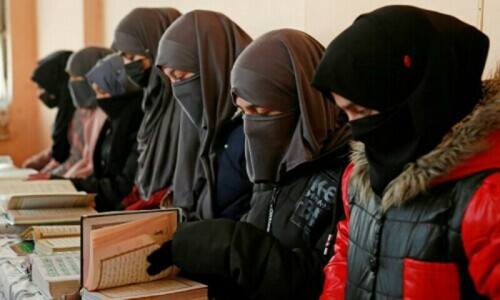
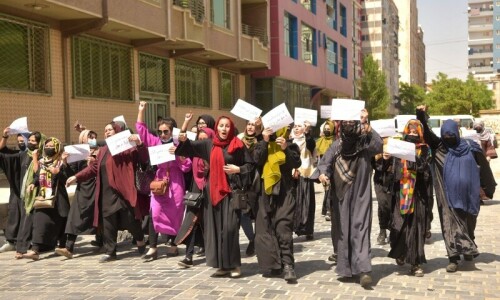
Since ousting a US-backed government in August 2021, the Taliban authorities have imposed severe restrictions on women, barring girls from secondary school, pushing women out of many government jobs, preventing them from travelling without a male relative and ordering them to cover up outside the home. Mr Bennett, who visited Kabul and Mazar-e-Sharif to fulfil his mandate, said he saw no improvements in the human rights situation in Afghanistan.
Published in Dawn, June 20th, 2023