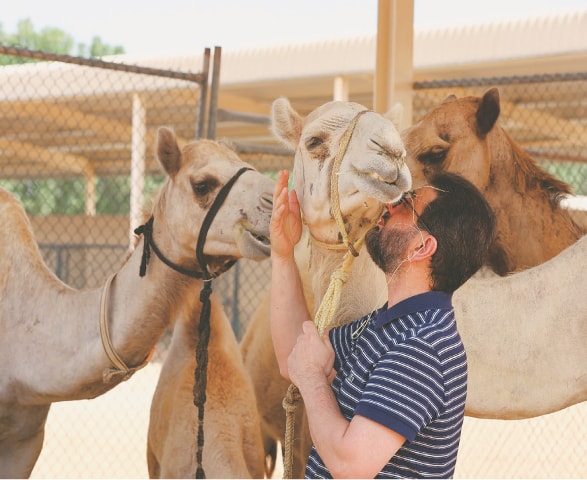
DUBAI: Dr Nizar Ahmad Wani kisses a surrogate camel at a farm of the Reproductive Biotechnology Centre.—Reuters

DUBAI: Having led the world’s first cloning of camels in 2009, Nisar Wani is now replicating a few dozen a year at a Dubai lab — a big business in the Gulf region where camels are cherished and can earn huge sums in beauty and racing contests.

“We collect these eggs from the ovaries of slaughtered animals. We have to mature them in the lab for 24 hours before they reach the stage where we can use them for the cloning process,” Wani said.

Reproductive cloning of animals uses a process called somatic cell nuclear transfer.

DNA is removed from a camel egg cell and replaced with DNA from a frozen body cell of a camel prized for some quality such as speed or beauty. The egg then develops into an embryo with no sperm needed.

Animal cloning is, however, time-consuming with low success rates.

“From a hundred embryos that we transfer, we can have five to ten pregnancies, and sometimes maybe three to six babies born,” said Wani, originally a veterinarian who has a PhD in animal reproduction.

The Reproductive Biotechnology Centre in Dubai works to preserve the cells of and reproduce elite racing camels, beauty contest winners, milking camels and prized males, Wani said.

It also uses interspecies cloning technology to preserve threatened species.

Published in Dawn, May 26th, 2023

Opinion

A long week

A long week

There’s some wariness about the excitement surrounding this moment of international glory.

Editorial

Unlearnt lessons
Updated 28 Apr, 2026

Unlearnt lessons

THE US is undoubtedly the world’s top military and economic power at this time. Yet as the Iran quagmire has ...
Solar vision?
28 Apr, 2026

Solar vision?

THE recent imposition of certain regulatory requirements for small-scale solar systems, followed by the reversal of...
Breaking malaria’s grip
28 Apr, 2026

Breaking malaria’s grip

FOR the first time in decades, defeating malaria in our lifetime is possible, according to WHO. Yet in Pakistan,...
Pathways to peace
Updated 27 Apr, 2026

Pathways to peace

NEGOTIATIONS to hammer out the 2015 Iran nuclear agreement took nearly two years before a breakthrough was achieved....
Food-insecure nation
27 Apr, 2026

Food-insecure nation

A NEW UN-backed report has listed Pakistan among 10 countries where acute food insecurity is most concentrated. This...
Migration toll
27 Apr, 2026

Migration toll

THE world should not be deceived by a global migration count lower than the highest annual statistics on record —...