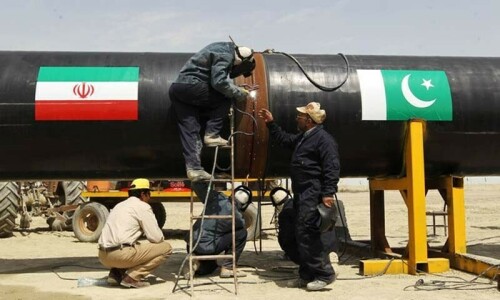
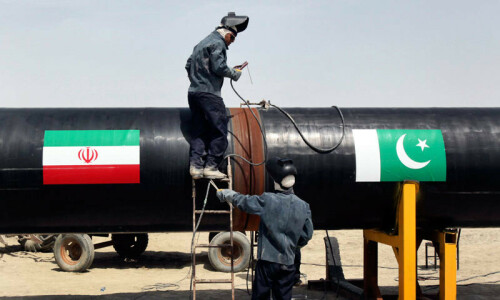
WASHINGTON: Pakistan is believed to have asked the United States to allow it to build a pipeline for buying gas from Iran or help it pay an expected $18 billion penalty it would face if it did not complete the project by March 2024.
Diplomatic sources told Dawn that Petroleum Minister Musadik Malik raised this issue with US officials when he visited Washington earlier this month, explaining to them that it’s legally bound to either complete the project by March 2024 or pay billions of dollars in penalty.
According to these sources, “Washington is still reviewing the request.”
And Michael Kugelman, a scholar of South Asian affairs at Washington’s Woodrow Wilson Centre, told Dawn the Biden administration “understands Pakistan’s problem” but was in no rush to respond. “With US relations with Iran having worsened in the Biden era, I don’t expect the administration to go out of its way to help any country move the needle forward on commercial cooperation with Tehran,” he said.
“But Washington also understands that Islamabad’s economic interests drive the need to take policy steps that may go against US interests,” he added.
“This suggests the administration will be in no hurry to make any move at all, even if this entails the possibility of China stepping in to help Pakistan cover the costs.”
When Pakistani journalists asked the US State Department about a recent meeting between Pakistani and Iranian leaders during the opening of a border trading post, one of their spokespersons said: “We are aware of this meeting” where energy cooperation between the two nations was also discussed but “we do not have any comment to provide on the engagement.”
The spokesperson, however, shared the details of recent US efforts to help Pakistan deal with this difficult situation. “Ensuring Pakistan’s economic growth, energy security and environmental sustainability remains a priority for our bilateral relationship with Pakistan and a cornerstone of our Green Alliance,” the US official said.
He explained how the United States has been a leading investor in Pakistan for the past 20 years, with $250 million in foreign direct investments in 2022.
The official said that US firms were already making significant investments to “help Pakistan provide expanded access to a cleaner, more resilient energy supply.”
For example, General Electric (GE) wind turbines, power control systems and equipment are widely used in Pakistan, which will increase Pakistan’s renewable energy capacity.
Last week, media reports suggested that Iran could hand Pakistan a whopping $18bn penalty if Islamabad fails to complete its portion of the pipeline by March 2024.
The reports said that earlier this month Iran informed a visiting Pakistani delegation that Pakistan should construct the gas pipeline as stipulated in their revised agreement or pay the penalty.
Iran has already finished its portion of the pipeline – from the gas field to the Pakistan border, where it should connect to the Pakistan portion.
The pipeline would allow Pakistan to start receiving 750 million cubic feet of gas from Iran daily once it’s completed and commissioned.
Pakistan signed the pipeline agreement in 2014, which included a condition that Islamabad will pay billions of dollars in penalties if it abandons the project.
Published in Dawn, May 25th, 2023