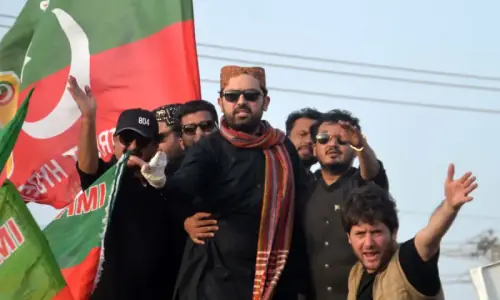
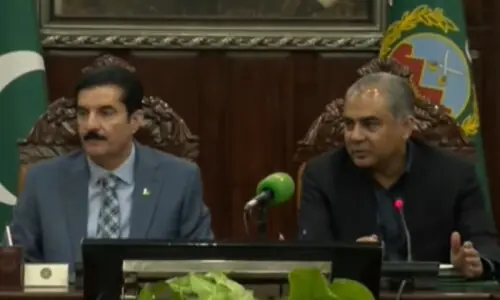
ISLAMABAD: The Supreme Court will resume hearing the election schedule case today after the government and the main opposition PTI sat together for three days and tried to talk out the issue.
The talks were aimed at developing a consensus on a date for elections in one go across the country. However, after negotiations concluded on Tuesday, the PTI told the court in a report that no solution could be arrived at and asked it to implement its order for holding polls in Punjab on May 14.
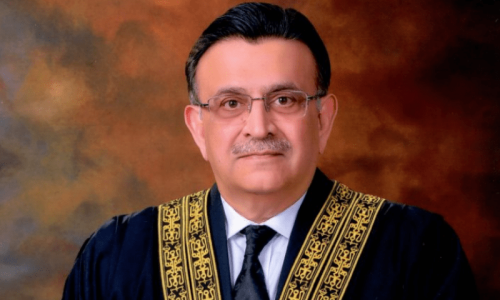
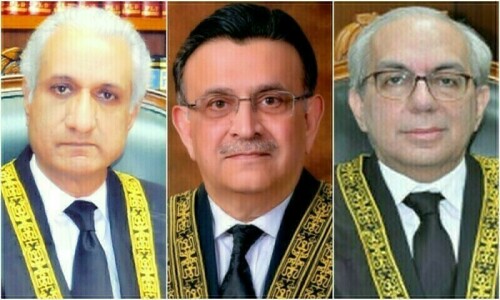
In the last hearing on April 27, the three-member Supreme Court bench — headed by Chief Justice of Pakistan Umar Ata Bandial and also consisting of Justice Ijazul Ahsan and Justice Munib Akhtar — also made it clear to the negotiating parties that its April 4 order on Punjab Assembly elections had remained unchanged.
Meanwhile, after the PTI submitted its version of negotiations with the coalition government, the federal government is also expected to submit a report to the court on Friday (today) about the talks’ outcome.
Coalition expected to submit report to apex court on outcome of negotiations
On Wednesday, the Election Commission of Pakistan (ECP) also asked the Supreme Court to revisit its Punjab polls order, arguing that only the commission had the authority to change the election programme under Section 58 of the Elections Act 2017.
In the April 27 hearing, the Supreme Court implored the political parties to sit together for the sake of the Constitution and arrive at a consensus date for holding simultaneous elections across the country.
In its order issued after the hearing, the court appreciated the efforts of all parties to try to end the current political impasse and in particular their voluntary agreement to enter into negotiations to choose a single date for elections.
The order mentioned that talks and negotiations between the government and the PTI were entirely to be their own effort without any direction or order from the court in any manner.
During that hearing, the order recalled, Attorney General for Pakistan Mansoor Usman Awan had briefed the court about the communication between the two sides during the Eid holidays. Mr Awan also contended that the initial steps had been taken to nominate members of both negotiating teams and matters relating to their meeting.
When the court asked why Senate Chairman Sadiq Sanjrani had been involved, PPP’s senior counsel Senator Farooq H. Naek had explained that the Senate was picked as the venue because it had equal representation from the provinces and all political parties were present there. Besides, he said, Mr Sanjrani would only facilitate talks without any substantive involvement.
Meanwhile, after the two sides concluded the talks on Tuesday, the PTI submitted a report to the Supreme Court on Wednesday, asking it to implement its April 4 order to hold elections in the Punjab Assembly on May 14.
The party said it was ready to accept simultaneous elections with certain conditions, including that the National Assembly and the assemblies of Sindh and Balochistan should also be dissolved on or before May 14 so that nationwide polls could be held in July.
Besides, to give a constitutional cover to holding elections to the Punjab and KP assemblies beyond the period of 90 days, MNAs belonging to PTI would rejoin the National Assembly and a one-time constitutional amendment validating the delay in elections beyond the period of 90 days for Punjab and KP assemblies shall be carried out by mutual consent of the political parties, the PTI had proposed.
Besides, all the parties shall agree that the election results would be accepted as a whole subject to individual grievances in accordance with the law. And an agreement in writing to the above effect shall be submitted before the Supreme Court to ensure that the implementation of the agreement was complied with by the parties in letter and spirit.
However, the PTI said in the report, the government rejected these proposals and instead proposed that the National Assembly and the Sindh and Balochistan assemblies could be dissolved on July 30, after which elections across the country would be held in 90 days, in the first week of October.
Published in Dawn, May 5th, 2023