Malnutrition in flood-hit areas has increased, says UN



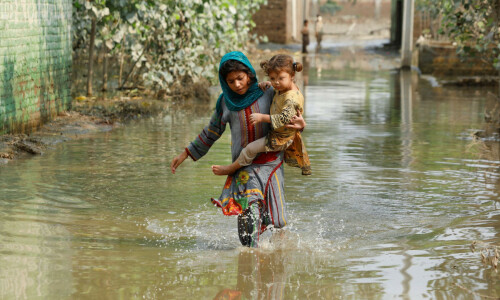
ISLAMABAD: The United Nations warned on Monday that the number of children suffering from malnutrition in the flood-affected areas had greatly increased compared to the pre-flood situation, which was already reaching emergency levels.
A rapid survey conducted in 15 flood-affected districts suggests that nearly one-third of children aged 6-23 months suffer from moderate acute malnutrition and 14 per cent from severe acute malnutrition — a life-threatening form of malnutrition — with girls being more affected than boys.
The number of children suffering from severe acute malnutrition with medical complications and admitted to hospital for treatment has also gradually increased since the floods, as global food prices soar.
“Even before the floods, child wasting was already reaching emergency levels, but what I am seeing now in villages is very worry-ing,” said UN Resident Coordinator in Pakistan, Julien Harneis.
$5.5m dedicated towards emergency nutrition, food security interventions
He announced dedicating $5.5 million of the $6.5 million allocation received from the Central Emergency Response Fund (CERF) towards emergency nutrition and food security interventions.
This additional $5.5 million will help Unicef, WFP, WHO and NGOs to provide emergency nutrition interventions as part of the government-led flood response in the most vulnerable communities of Balochistan and Sindh, with OCHA coordinating and ensuring that funds are used in an efficient manner.
“We are grateful for the global community’s support so far, but much more is needed to help the government provide the increasing numbers of children who are at risk of death with immediate therapeutic food and care.
“We must help the government avert a nutrition crisis which would have dangerous and irreversible consequences for millions of children, and for the future of Pakistan,” he said.
But with only one-third of the nutrition interventions included in the Floods Response Plan funded so far, additional funding is urgently required to implement early identification, integrated prevention and treatment of malnutrition in a greater number of villages and healthcare facilities.
There is also a need to increase the number of interventions that improve availability, affordability and accessibility to nutritious foods that protect children from wasting.
Published in Dawn, April 18th, 2023