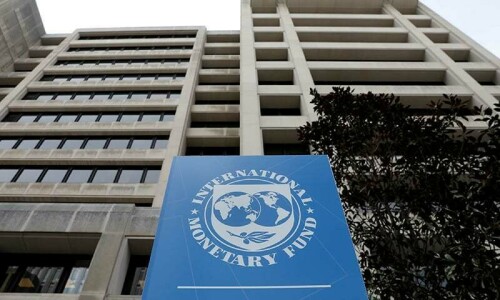
WASHINGTON: The International Monetary Fund (IMF) has said it hopes to complete its current programme with Pakistan successfully.
Since early February, Pakistan has been negotiating with the IMF to revive the $7 billon bailout programme to secure $1.1bn tranche. Pakistan hopes that the deal will also unlock funds from other donors waiting for IMF’s endorsement.
“My hope is that with the goodwill of everyone, with the implementation of what has been already agreed by the Pakistani authorities, we can complete our current programme successfully,” IMF Managing Director Kristalina Georgieva said at a news briefing in Washington on Thursday.
At her annual news conference at the IMF and World Bank’s spring meetings, she pointed out that the Fund’s projected global 2.8 per cent in 2023 was “the weakest medium-term forecast in decades”. The growth will remain weak, at around 3pc, over the next five years, she added.
“Underlying inflation remains stubbornly high, geo-economic fragmentation affects trade and capital flows, and downsides risks have increased,” she warned. “Fighting inflation and safeguarding financial stability have become more complex with the recent banking sector pressures.”
Responding to a question about the impact of climate change on Pakistan’s economy, Ms Georgieva said in 2011 she had the opportunity to see what climate change meant for the people of Pakistan. “And I know that (last summer’s) flood is much more dramatic than the one I witnessed,” she added.
“No question Pakistan will continue to be on the frontline of the climate crisis. And that means that communities also think about the future of agriculture in a more climate sustainable manner,” she said.
Responding to a question about IMF-Pakistan talks for the revival of the 2109 loan package, Ms Georgieva said: “We have been working very hard with the authorities in Pakistan within the context of our current programme to make sure that Pakistan has the policy framework that makes it possible to avoid what you are talking about.”
The reporter who asked the question had hinted at the possibility of Pakistan’s burgeoning debt becoming unsustainable.
But Ms Georgieva said the purpose of the IMF-Pakistan talks was to avoid getting to a point where the country’s debt may become unsustainable. “We are not there yet and it’s better not to get there,” she said.
The IMF and Pakistani officials, she said, were also discussing how to support Pakistan “in terms of providing financial assurances so we can complete the programme”.
Observers pointed out that while the IMF chief ‘hoped’ that the talks would lead to the renewal of its package to Pakistan, she sounded less enthusiastic than Pakistani officials who have more than once assured their nation that they were close to clinching the deal.
Last week, Finance Minister Ishaq Dar cancelled his visit to Washington for the spring meetings, citing domestic political turmoil as the reason. But diplomatic sources in Washington say Mr Dar did so because he wanted to avoid raising hopes in Islamabad.
Published in Dawn, April 14th, 2023