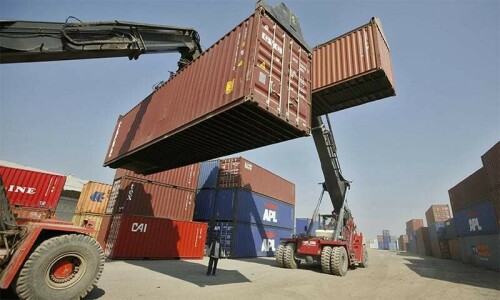
ISLAMABAD: Pakistan’s exports of merchandise shrank for the seventh month in a row dipping by 14.76 per cent year-on-year to $2.36 billion in March, reflecting fear of massive layoffs in the export sector of the country.
In the first nine months (July to March) of 2022-23, exports were down 9.87pc at $21.04bn compared to $23.35bn in the corresponding period last year, according to data released by the Pakistan Bureau of Statistics on Monday.
The export proceeds are declining mainly because of internal and external factors raising fears about the closure of industrial units, especially textile, and clothing.
Imports dipped 40.25pc to $3.82bn in March compared to $6.40bn over the corresponding month of last year. In the first nine months, imports fell 25.34pc to $43.94bn this year from $58.85bn over the corresponding period last year.
Between July and March FY23, the trade deficit decelerated 35.5pc to $22.9bn from $35.50bn over the corresponding months of last year. In March, the trade deficit fell 59.75pc to $1.46bn on a year-on-year basis.
Trade deficit decelerates to $23bn in first nine months
The exports started posting negative growth in the first month of the current fiscal year — July — barring August when a slight increase was recorded because of the backlog of the preceding month. Export contraction is a worrisome factor, which will create problems in balancing the country’s external account.
The drop especially in textile and clothing, which constitutes more than 60pc of total exports shows the government would find it difficult to achieve the export target this fiscal year.
The declining textile exports are a result of the federal government’s lack of strategy and inability to prioritise effectively - it seems they are simply running the government on a day-to-day basis, Patron in Chief Pakistan Textile Exporters Association Mr Khurram Mukhtar told Dawn.
He said the root causes of the export decline include working capital shortages, and refunds being stuck such as sales tax, deferred sales tax, income tax, drawbacks of local taxes and levies, technology upgradation fund, and duty drawback.
Unfortunately, the faster refund system is not functioning as intended, with refunds now taking 3-5 months to process instead of the promised 72 hours. Additionally, the sector is facing a substantial increase in financial and energy costs, the exporter further lamented.
Without addressing these issues, it will be impossible for the textile industry to compete regionally on cost and get back on track with exports, Mr Mukhtar said. It’s particularly concerning that the largest employer in the country is being neglected by the government.
Mr Mukhtar stressed the need for a dialogue between industry leaders and the government, with the right priorities identified and addressed.
Pakistan Apparel Forum chairman Jawed Bilwani said that it has become difficult for exporters to place orders for the import of raw materials and other inputs procured locally. He said the State Bank of Pakistan has created hurdles in opening letters of credit which led to a decline in exports.
He said buyers have withheld their orders mainly because of political and economic uncertainty in the country. He suggested the government should come up with clear statements to give signals to foreign buyers that their orders will be delivered on time. “We have no choice but to give assurances to buyers to meet their demands”, he said.
Mr Bilwani lamented that Prime Minister Shehbaz Sharif has cancelled four meetings with exporters.
He said the foreign exchange reserves of the country can only be built through an increase in exports.
He predicted exports will fall by 17pc in April. He said the government discontinued subsidies on electricity and gas for the export sector on March 1 which has rendered Pakistani exporters uncompetitive on the world markets.
Exporters believe that one of the main reasons behind falling exports was the exchange rate instability.
Published in Dawn, April 4th, 2023