Gas price hike to affect the rich only: Musadik


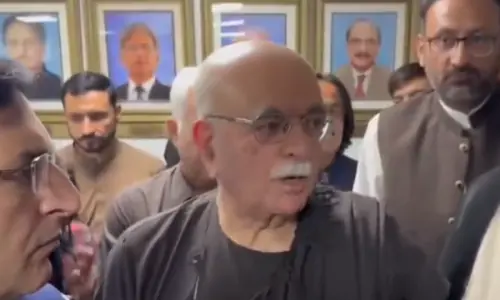
KARACHI: Minister of State for Petroleum Musadik Malik claimed on Thursday the latest gas price increase will mainly affect the rich as the poor remain protected from the tariff revision.
Speaking to the press on the sidelines of a business summit, the minister said the prevailing gas prices are a symbol of elite capture, a term for the use of public resources for the benefit of a select few with superior social status.
“Saudi Arabia gives gas to its fertiliser and power plants at $2 (per unit). Qatar gives it at $3. Bahrain gives it at $4. Pakistan gives it for 70 cents and $1.30 (respectively). This is the kind of elite capture we have in this country. Are we richer than Saudi Arabia or Qatar?”
His remarks were in the wake of the government’s recent decision to increase gas prices in line with the recommendation of the International Monetary Fund. The weighted average cost of gas has gone up by 43 per cent to Rs885 per million British thermal units from Rs620.
“Elite capture isn’t a cliché. It’s real. It takes away opportunities from millions and millions of the poor by a handful of people who have the political wherewithal to take gas at $1.30 (per unit). It has to stop,” he said.
Taking part in a panel discussion, former central bank chief Shamshad Akhtar said policy reversals and unpredictability have compounded political uncertainty. An unprecedented monetary stimulus to avert the pandemic-induced economic contraction led to the revival of growth in 2021, she said. However, the stimulus came at a high cost because it put “massive refinancing… in the wrong pockets”.
Economic growth faltered in the wake of “frequent economic and political disruptions,” she said, compounding a persistent neglect of productivity and competitiveness over the years.
She called for debt restructuring. “We have to stop playing the musical chairs, of passing the parcel of new borrowings to settle due repayments and claiming our debt to be sustainable,” she noted.
World Bank Country Director Najy Benhassine said the real crisis of Pakistan is one of human capital. Referring to the stunting rate of roughly 40 per cent among children under five years of age as well as 20 million out-of-school kids, he said the possibility of long-term growth in Pakistan is minimal.
He called for increasing taxes on property transactions, especially in Karachi, based on market value. The “huge” funds raised through such taxes should then be deployed to improve urban infrastructure, he said.
Mr Benhassine spoke passionately about doing away with import restrictions. A 10pc increase in the import tariff increases the profit margin of a domestic company working for the domestic market by as much as 40pc, he said. “Why would you export if you’re protected? Why wouldn’t you put all your money in real estate if it isn’t taxed?” he said.
Published in Dawn, February 17th, 2023