Beijing says second balloon flying over Latin America is Chinese

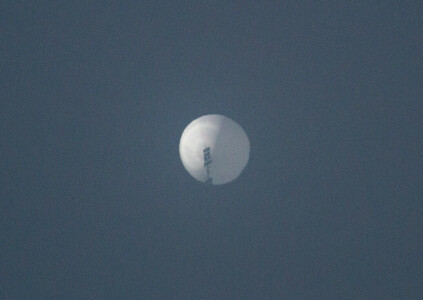
Beijing confirmed on Monday a balloon spotted flying over Latin America is Chinese, while the United States worked to recover what it claimed was an unmanned spy craft it shot down at the weekend.
China has expressed fury at Washington’s decision to shoot down a device that it insists was an unmanned weather surveillance aircraft that had veered off course last week.
That balloon sparked outrage in the United States, which accused China of an “unacceptable violation” of its sovereignty and prompted Secretary of State Antony Blinken to call off a planned trip to Beijing.
Beijing acknowledged on Monday that the latest balloon, spotted by US and Colombian officials flying over Latin America at the weekend, was also Chinese.
Its foreign ministry said the device was of “a civilian nature and used for flight tests”.
“Affected by weather forces in addition to its manoeuvrability being limited, the airship deviated greatly from its expected course, and accidentally entered Latin American and Caribbean airspace,” spokesperson Mao Ning told a media briefing.
That statement came three days after what the Pentagon characterised as another Chinese spy balloon had been seen across Latin America.
Colombia’s air force reported at the weekend an object with “characteristics similar to those of a balloon” was detected and monitored until it left Colombian air space.
Investigations were being conducted in coordination with other countries and institutions to establish the object’s origins, it said.
Surveillance balloon
The other balloon had spent several days flying over North America before Washington said on Saturday an F-22 fighter jet had shot it down off the coast of South Carolina.
Pentagon officials had described it as a “high-altitude surveillance balloon” and said Washington had taken steps to block it from collecting sensitive information.
General Glen VanHerck, commander of US forces in North America, said in a statement Sunday navy personnel were “currently conducting recovery operations, with the US Coast Guard assisting in securing the area and maintaining public safety”.
Beijing has said the balloon that was shot down was primarily gathering weather data and that it had been blown off course.
In return, it has also said the United States “seriously impacted and damaged” relations between the two countries by shooting it down and lodged a formal complaint with the US embassy in Beijing.
China’s vice foreign minister Xie Feng warned that Beijing “reserves the right to make further necessary reactions”.
‘A clear message’
Chuck Schumer, the US Senate Democratic leader, said the downing of the balloon “wasn’t just the safest option, but it was the one that maximized our intel gain”.
That was because any instrumentation on the airship was more likely to survive a water landing than if it had been shot down earlier over land.
“We sent a clear message to China that this is unacceptable,” he said in a statement.
Schumer said the full Senate would receive a classified briefing on February 15.
Former US Joint Chiefs of Staff chair Mike Mullen was asked on ABC News if he thought elements in the Chinese military might have launched the balloon to disrupt the Blinken visit.
“Clearly, I think that’s the case,” he said.
Mullen said the craft was manoeuvrable and rejected China’s suggestion it might have been blown off course.
“It has propellers on it,” he said. “This was not an accident. This was deliberate. It was intelligence.”
Blinken’s visit would have been the first to China by a US secretary of state since Mike Pompeo’s in 2018.
Plans for the visit were announced after President Joe Biden held a rare summit with Chinese counterpart Xi Jinping in Bali in November.