Three foreign NGOs stop work in Afghanistan after Taliban ban on women staff


Three foreign aid groups announced on Sunday they were suspending their operations in Afghanistan after the country’s Taliban rulers ordered all non-governmental organisations (NGOs) to stop women staff from working.
Their announcement prompted warnings from a top UN official in Afghanistan and from NGOs that humanitarian aid would be hard hit.
“We cannot effectively reach children, women and men in desperate need in Afghanistan without our female staff,” Save the Children, the Norwegian Refugee Council and CARE said in a joint statement.
“Whilst we gain clarity on this announcement, we are suspending our programmes, demanding that men and women can equally continue our lifesaving assistance in Afghanistan.”
Saturday’s order issued by the ministry of economy drew swift international condemnation.
The ban is the latest blow against women’s rights.
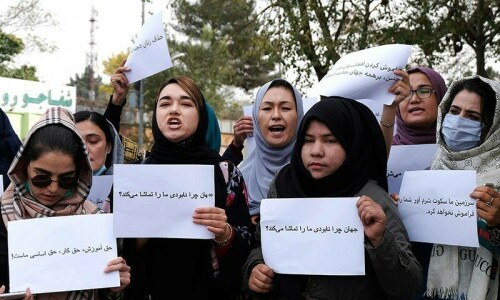
Less than a week ago, the Taliban also barred women from attending universities, prompting global outrage and protests in some Afghan cities.
The ministry threatened to suspend the operating licences of aid organisations that failed to stop women from working.
It said it had received “serious complaints” that women working in NGOs were not observing a proper Islamic dress code, a charge also used by authorities to justify banning university education.
But the UN chief’s deputy special representative for Afghanistan, Ramiz Alakbarov, told AFP that the ban will impede aid delivery to millions of people and also have a “devastating” impact on the country’s dilapidated economy.
“It will be very difficult to continue and deliver humanitarian assistance in an independent and fair way because women’s participation is very important,” Alakbarov said.
“We are going to discuss this matter with the authorities … We will insist on reversal of the ban.”
Germany’s Foreign Minister Annalena Baerbock on Sunday also called for a “clear reaction from the international community”.
Devastating economic impact
At a meeting of humanitarian officials on Sunday, there was no decision over whether all NGOs would suspend operations, according to Alakbarov, who added that more discussions would be held.
He acknowledged that the ban would impact the UN’s operations as it distributes aid through a vast network of NGOs.
“There is a direct impact on our ability to deliver the programme and on our ability to deliver assistance like food and non-food items,” he said.
The ban will also have a “very devastating” impact on Afghanistan’s economy, already in a tailspin since the withdrawal of foreign forces in August last year.
“All assistance which is being provided to Afghanistan in this period is very critical, both for the nutritional security and to the job security of the people,” he said.
Afghanistan’s economic crisis has worsened since the Taliban seized power, which led to Washington freezing billions of dollars of assets and foreign donors cutting aid.
Dozens of organisations work across remote areas of Afghanistan and many employee women, with several warning the ban, will stymie their activities.
“Some NGOs have up to 2,000 women employees, and in most of the cases they are the only breadwinners for their families,” Alakbarov said.
Hell for women
Shabana, 24, told AFP she was the only earning member in her family.
“If I lose my job, my family of 15 members will die of hunger,” said Shabana, who has worked for a foreign NGO for decades and gave only one name.
“While the world is celebrating the arrival of the new year, Afghanistan has become a hell for women.”
The ministry said women working in NGOs were not observing “the Islamic hijab and other rules and regulations pertaining to the work of females in national and international organisations”.
But NGO staff dismissed the charge.
“Our offices are gender segregated, and every woman is properly dressed,” said Arezo, who works for another foreign NGO and also gave only one name.
It remained unclear whether the directive impacted foreign staff at NGOs.
The international community has made respecting women’s rights a sticking point in negotiations with the Taliban government for its recognition and the restoration of aid.
On Tuesday, the minister of higher education banned women from universities, also accusing them of being improperly dressed.
That ban triggered widespread international outrage and protests, which were forcefully dispersed by the authorities.
The Taliban had already barred teenage girls from secondary school.
Women have also been pushed out of many government jobs, prevented from travelling without a male relative and ordered to cover up outside of the home, ideally with a burqa.
They are also not allowed to enter parks or gardens.