0
0

ISLAMKOT: Contrary to the general impression that Tharparkar is miles and miles of wasteland, the soil here is actually fertile. The whole area can also be turned into an oasis if only there is water here.
Now with plenty of water for the plants, Islamkot in Tharparkar is turning green, but not with envy.
Just five or six years ago, the land where now the Bashir Ansari Green Park exists here in Islamkot was barren. Now it serves as a recreational facility for the local community with a park, a zoo with multiple species of animals and birds, a designated ladies area, etc., etc.
Bashir Ansari, after whom this park has been named, was a geologist. When the coal reserves were discovered in Islamkot, he was researching and working on where these reserves were available and at what levels. For this work, he had dug a few deep wells some of which collapsed unfortunately for some strange reason. But the wells were associated with the geologist’s longtime in-depth research. He couldn’t bear the loss of his years of work and took it to heart. It resulted in his death.
The Sindh Engro Coal Mining Company (SECMC) wanted to preserve the wells so they developed a park around it. This park was stretched across 30 acres initially, but it has spread to over 65 acres now with various sections. Today there are also around 100,000 to 150,000 plants and trees planted here.
Biosaline groundwater is transforming the town into an oasis
“We try not to plant trees that need sweet water to grow because human beings and animals have the first right to the sweet water, which as it is doesn’t come by easily,” said deputy manager environment Nimra Hussain, who leads all the green projects of the health, safety and environment (HSE) department and SECMC.
“We get plants that do well in saline water that is pumped out from the coal mines. This ground water needs to be pumped out to reach the coal seams for mining. This water from the mines is not poisonous or anything. But it cannot be used for conventional purposes due to its higher salt content. Still, it is a resource that we can use to benefit the community and the environment by using it in growing plants and trees and different crops.
The native plant species here actually do quite well on this water. Considering this our strategy is to grow young plants or saplings on RO plant-treated water for six to eight months before switching to saline water,” she explained.
Another SECMC project is the Thar Million Tree Project. It was decided by the company back in 2016 to plant one million trees in Tharparkar. It started in 2017. The sustainable trees in the area include Neem, Moringa and Australian Barber. Many of them are growing at the Bashir Ansari Green Park.
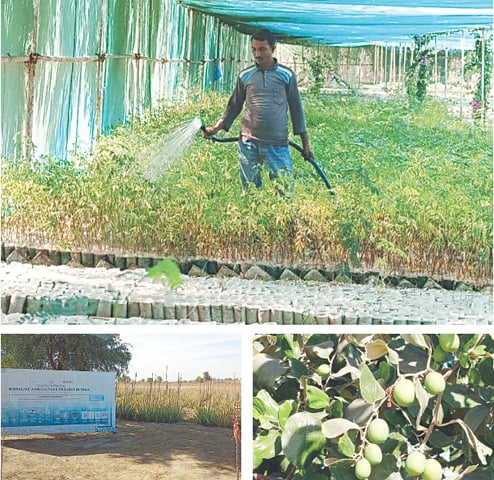
And the saplings for these trees are growing in Sindh’s biggest private sector nursery in Islamkot, which has a capacity of 500,000 saplings. “We grow different saplings in-house there,” said Ms Nimra.
“So having started in 2017, the Thar Million Tree Project met its goal of planting one million trees in 2021, on the World Environment Day [June 5]. Obviously all plants don’t survive hundred per cent for many reasons. We have recorded a 72 per cent survival rate here. Therefore, we are doing over and above plantation to ensure 100 per cent survival,” she explained.
Also started in 2017, the Biosaline Fruit and Fodder Farm, a joint collaboration between the SECMC and the Pakistan Agriculture Research Council (PARC), which is another green or sustainable project spread over 40 acres of agriculture land.
It is a pilot project with various crops growing on saline water such as aloe vera and jujube fruit, and fodder grasses such as Rhodes grass and Sesbania for livestock.
“We collaborated with different research and educational institutes to do this, including the local agriculture promoting institute PARC to see what species of plants, including fodder, could be grown here because the locals depend on agriculture and livestock, but whatever they grew themselves from stored rain water was not enough. But the way we are growing crops here a normal peasant can also replicate.
“The labour at the farm, around 50 to 60 persons, is also free to take home the fruits and fodder growing there for themselves and for their animals,” Ms Nimra shared. “We donate plants too. For example, we donated our saplings to the Sindh forest department, the Urban Forest, Hands, Dua Foundation who were also working on smaller scale with the same aim as us,” she added.
And with so many targets met and things looking up on the vegetation front, the SECMC is now turning attention to now also looking at the impact of all the greenery on the environment and biodiversity in the area. “We are looking at tangible results of how much carbon is sequestered, and how many more species of animals and birds are seen here as a result of biodiversity. We will devise further plantation strategies on all that.”
Published in Dawn, December 23rd, 2022