China calls for oil trade in yuan at Middle East summit


RIYADH: President Xi Jinping told Gulf Arab leaders on Friday that China would work to buy oil and gas in yuan, a move that would support Beijing’s goal to establish its currency internationally and weaken the US dollar’s grip on world trade.
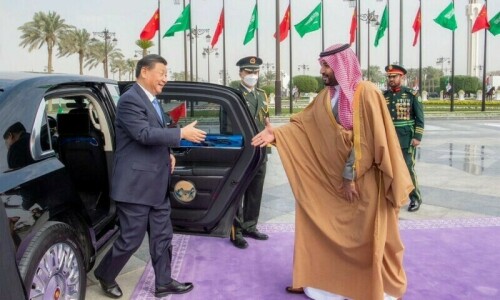
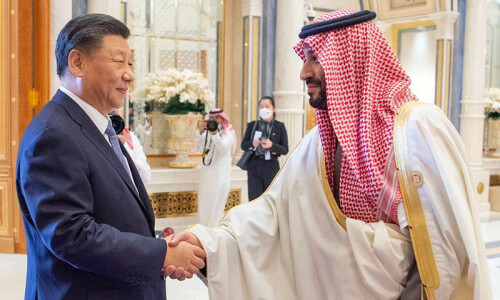
Xi was speaking in Saudi Arabia where Crown Prince Mohammed bin Salman hosted two “milestone” Arab summits with the Chinese leader which showcased the powerful prince’s regional heft as he courts partnerships beyond close historic ties with the West.
Top oil exporter Saudi Arabia and economic giant China both sent strong messages during Xi’s visit on “non-interference” at a time when Riyadh’s relationship with Washington has been tested over human rights, energy policy and Russia.
Any move by Saudi Arabia to ditch the dollar in its oil trade would be a seismic political move, which Riyadh had previously threatened in the face of possible US legislation exposing Opec members to antitrust lawsuits.
Xi said Beijing would continue to import large quantities of oil from Gulf Arab countries and expand imports of liquefied natural gas, adding that their countries were natural partners who would cooperate further in upstream oil and gas development.
China would also “make full use of the Shanghai Petroleum and National Gas Exchange as a platform to carry out yuan settlement of oil and gas trade,” he said.
Beijing has been lobbying for use of its yuan currency in trade instead of the U.S. dollar.
China’s growing influence in the Gulf has unnerved the United States. Deepening economic ties were touted during Xi’s visit, where he was greeted with pomp and ceremony and on Friday met with Gulf states and attended a wider summit with leaders of Arab League countries spanning the Gulf, Levant and Africa.
At the start of Friday’s talks, Prince Mohammed heralded a “historic new phase of relations with China”, a sharp contrast with the awkward US-Saudi meetings five months ago when President Joe Biden attended a smaller Arab summit in Riyadh.
Though Saudi Arabia and China signed several strategic and economic partnership deals, analysts said relations would remain anchored mostly by energy interests, though Chinese firms have made forays into technology and infrastructure sectors.
Saudi Arabia agreed an MoU with Huawei this week on cloud computing and building high-tech complexes in Saudi cities. The Chinese tech giant has participated in building 5G networks in Gulf states despite US concerns over a possible security risk in using its technology.
Published in Dawn, December 10th, 2022