Comment: Pakistan face improbable path to the semi-final


PAKISTAN are alive but barely kicking in this year’s World T20 after a six-wicket victory over minnows the Netherlands. They must win their remaining matches and pray that other results go in their favour if they are to qualify for the semi-finals.
The calculation grew more complex with South Africa’s unexpected win over India. That leaves South Africa requiring one win to qualify and they still have the Netherlands to play.
Pakistan’s hopes now rest on Bangladesh beating India, and then themselves beating South Africa and Bangladesh by a sufficient margin to earn qualification on net run rate. This route to the semi-finals fails if Zimbabwe, as unlikely as it sounds, win their last two games.
Read: Top 5 innings of World Cup 2022 so far
This sequence of events seems improbable, but Pakistan must believe that they can still qualify until it is mathematically impossible for them to do so. The unknown factor is the weather, which could rob any of the teams of their qualification chances.
Pakistan are paying a heavy price for their shock defeat to Zimbabwe, but the responsibility rests on the failures of preparation whereby the problems of the batting order were persistently ignored and glossed over, combined with relentless backing for a strategy that was producing inconsistent results.
The second major failing was to send the squad to Australia without a fast bowling all-rounder, which limited the team’s options and meant that Pakistan must choose between an imbalance that leaves them either short in fast bowling or an imbalance that means they are short in batting.
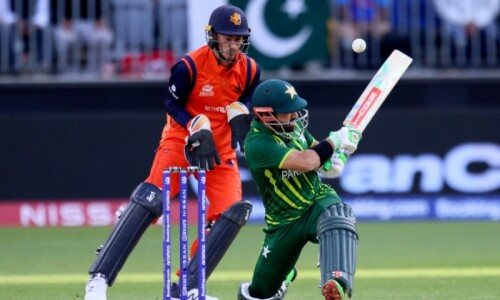
The disparity in Pakistan’s specialist skills was re-emphasised in Perth, where the bowlers restricted the Netherlands to 91 in 20 overs and the batsmen delivered the win in unconvincing fashion against an ordinary bowling line up.
Pakistan stuck with their four pronged pace attack, which is the right way to go in Australia with the squad available. It proved too strong for the Netherlands. Mohammad Wasim once again justified his selection with two wickets, and the fast bowlers strangled the Netherlands innings before Shadab Khan cleaned up with three wickets.
Even with Shaheen Shah Afridi not yet back to his best, Pakistan’s bowling attack can compete with any at this World T20. But it does create a selection dilemma around whether to select all three of their spin bowling all-rounders — Shadab, Mohammad Nawaz, and Iftikhar Ahmed — all of whom aren’t yet consistent contributors in the middle order.
The alternative would be to strengthen the team with another batsman, although any batsman that Pakistan try seems to be out of form. Neither Asif Ali nor Haider Ali are inspiring confidence, and the failure to develop Haider’s potential into a successful international cricketer is particularly perplexing.
Pakistan’s over reliance on Babar Azam and Mohammad Rizwan has been exposed. It was a bad strategy since it never catered for the simple fact that even world class players have dips in form. Rizwan was back in the runs in Perth, although the Netherland’s bowlers didn’t extract the bounce with which Zimbabwe had so troubled Pakistan’s batsmen.
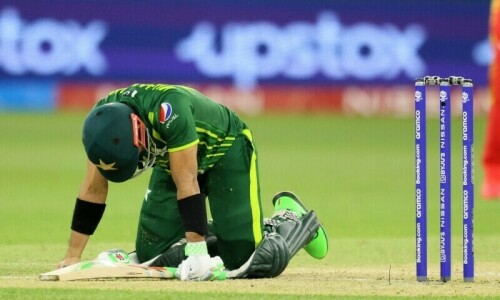
Babar’s struggles continued with a run out, but his class isn’t in doubt. What is in doubt is whether the strategy of opening with Babar and Rizwan is best for the team. To change strategy now, though, would be a risk given Pakistan’s perilous position in the tournament, but it might be a risk worth taking given Fakhar Zaman’s return and his ability to exploit the fielding restrictions in the first six overs.
Pakistan’s hopes now hang by a thread and the inquest will be hard to stop into how Pakistan came to back themselves into a corner with their batting strategy and whether they have the right support staff and selection to maximise the country’s potential in T20 cricket.
It will also be hard to prevent questions about Babar’s position as captain in all formats. The fundamental truth that Pakistan cricket has failed to acknowledge is that overburdening players in the modern game is a doomed approach. Pakistan have done that with Babar, Rizwan, and Afridi. They are on the same path with Haris Rauf.
These issues aren’t being raised in hindsight, and they are issues that the Pakistan Cricket Board has brushed aside. It would be wrong to rule out a miracle for Pakistan in this year’s World T20, although any hopes of success are built on weak foundations. It’s a shame for world cricket because Pakistan’s bowling attack deserves better than to be let down again and again by chronic failures of batting and planning.
Published in Dawn, October 31st, 2022