Defiant Iranians hit the streets again to protest crackdown

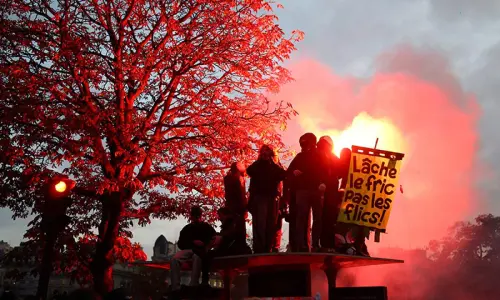
PARIS: Iranians took to the streets around the country again on Friday to protest against the killings of youths in a widely documented crackdown on demonstrations sparked by Mahsa Amini’s death.
The clerical state has been gripped by six weeks of protests that erupted when Amini, 22, died in custody after her arrest for an alleged breach of Iran’s strict dress rules for women.
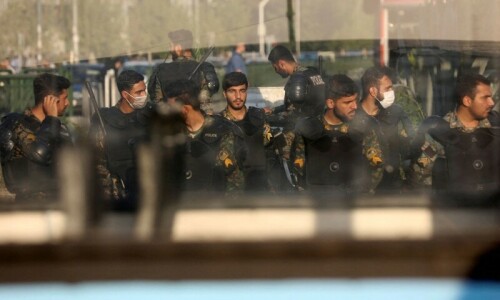
Security forces have struggled to contain the women-led protests, that have evolved into a broader campaign to end the Islamic republic founded in 1979.
Videos widely shared online showed people rallying Friday across Iran, including in Mahabad, the flashpoint western city where a rights group said security forces had killed at least four people in the past two days.
The demonstrations came despite a crackdown that the Oslo-based Iran Human Rights group said Friday had killed at least 160 protesters, an increase of 19 since its last toll on Tuesday, and including more than two dozen children.
The IHR called for “diplomatic pressure” on Iran to be stepped up, with its head Mahmood Amiry-Moghaddam warning of a “serious risk of mass killings of protesters which the UN is obligated to prevent”.
Another 93 people were killed during separate protests that erupted on September 30 in the southeastern city of Zahedan over the reported rape of a teenage girl by a police commander, IHR says.
Automatic gunfire
Violence erupted in Zahedan again on Friday “when unknown people opened fire” killing one person and wounding 14 others, including security forces, the official IRNA news agency reported.
IHR said security forces opened fire at protesters in the southeastern city, with deaths reported “including a 12-year-old boy”.
The Norway-based Hengaw organisation added that two more people were killed Thursday in Baneh, another city near Iran’s western border with Iraq.
The bloodshed in Mahabad came as mourners paying tribute to Ismail Mauludi, a 35-year-old protester killed on Wednesday night, made their way from his funeral towards the governor’s office, Hengaw said.
“Death to the dictator,” protesters yelled, using a slogan aimed at Iran’s supreme leader Ayatollah Ali Khamenei, as the governor’s office burned, in an online video.
Other verified footage showed clashes outside the western city of Khorramabad near the grave of Nika Shahkarami, a 16-year-old killed by security forces, where dozens of people were marking the end of the traditional 40-day mourning period.
“I’ll kill, I’ll kill, whoever killed my sister,” they were heard chanting, in a video posted online by the US-based Human Rights Activist News Agency (HRANA).
Dozens of men were seen hurling projectiles under fire as they drove back security forces.
At least 20 security personnel have been killed in the Amini protests, rights groups say, and at least another eight in Zahedan.
Local media meanwhile quoted a joint statement from Iran’s intelligence ministry and the Revolutionary Guards accusing the United States’ Central Intelligence Agency of plotting against the Islamic republic.
The CIA was conspiring with spy agencies in Israel, Britain and Saudi Arabia, “to spark riots” in Iran, the statement said.
‘More killings’
The latest Amini protests were held in defiance of warnings from Khamenei and ultra-conservative President Ebrahim Raisi, who appeared to try to link protests to a mass shooting Wednesday at a key Shiite Muslim shrine in the southern city of Shiraz after prayers, that state media said killed at least 15 worshippers.
But the protests triggered by Amini’s death on September 16 show no signs of dwindling, inflamed by public outrage over the crackdown that has cost the lives of many other young women and girls.
The Iranian authorities have had to quell the protests through various tactics, possibly in a bid to avoid fuelling yet more anger among the public.
They staged rallies on Friday in Tehran and other cities to denounce the Shiraz attack, which was claimed by the Islamic State group.
“I doubt that the security forces have ruled out conducting a larger-scale violent crackdown,” said Henry Rome, an Iran expert at the Washington Institute.
For now, hey “appear to be trying other techniques” including “arrests and intimidation, calibrated internet shutdowns, killing some protesters, and fuelling uncertainty”, Rome said.
“They may be making the calculation that more killing would encourage, rather than deter, protesters -- if that judgement shifts, then the situation would likely become even more violent,” he added.
An official Iranian medical report concluded Amini’s death was caused by illness, due o “surgery for a brain tumour at the age of eight”, and not police brutality.
Lawyers acting for her family have rejected the findings and called for a re-examination of her death.
Published in Dawn, October 29th, 2022