Responsibility was mine, actual rule was someone else's: Imran on his time as prime minister

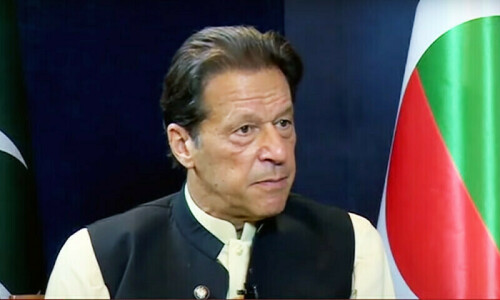
PTI Chairman Imran Khan on Wednesday said that while running the country was supposed to be his responsibility during his time as the prime minister, the actual rule was of "someone else".
Imran, who has claimed before as well that he did not have complete liberty to run the country, did not clarify who he was referring to.
The former prime minister made the latest claim in an interaction with journalists in Lahore.
He further said that if "even half the power would have been given" to him in his three and a half years in power, his government would have competed with the performance of Sher Shah Suri — the famed founder of the Sur Empire.
It is not the first time the PTI chief has insinuated that his government was not at liberty to call all the shots.
In an interview in June with anchorperson Sami Ibrahim for Bol News programme Tajzia, the former prime minister had admitted he did not enjoy absolute power, indicating that the actual centres of power in the country lay elsewhere and "everyone knows where that is."
In the interview, Imran was asked to recall the events of the night of the no-confidence vote against him, who was issuing orders and who had impeded the cases against the PPP and PML-N leaders.
Imran said his government had been "weak" when it came to power and had to seek coalition partners, adding that if the same situation were to arise again, he would opt for reelections and seek a majority government or none at all.
"Our hands were tied. We were blackmailed from everywhere. Power wasn't with us. Everyone knows where the power lies in Pakistan so we had to rely on them," he said without elaborating any further on who he was referring to.
"We relied on them all the time. They did a lot of good things too but they didn't do many things that should've been done. They have the power because they control institutions such as NAB (National Accountability Bureau), which wasn't in our control."
He claimed that while his government had the responsibility, it did not have all the power and authority.
"No management works if I have responsibility but have no complete power and authority. A system works only when responsibility and authority are in one place."
Imran said it was imperative for the country to have a "strong army" due to the threat posed by the enemies but said there was also the need to strike a "balance" between having a strong army and a strong government.