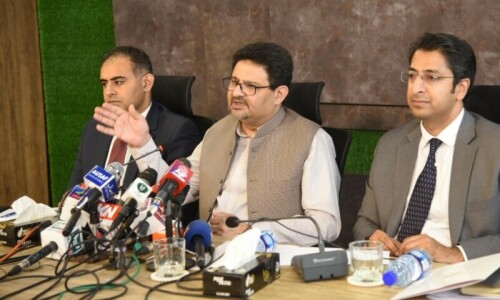
The Finance Division on Friday denied reports that the government planned to impose taxes amounting to Rs80 billion through a mini-budget.
In a statement, it pointed out that Finance Minister Miftah Ismail, during his press conference on August 18, had also not mentioned that taxes worth Rs80bn would be announced through an ordinance.
“Reference news published … that the government plans to present mini-budget for collection of Rs80 billion revenue through [an] ordinance. The news is misleading and factually incorrect,” it asserted.
The finance minister had on Thursday announced that the government would lift a ban imposed three months ago on the import of non-essential and luxury items and outlined fresh revenue measures of more than Rs50bn.
In its statement yesterday, the Finance Division said the government would promulgate an ordinance in a “few days” through which it would impose variable taxes on traders, starting with a sales tax of five per cent and an income tax of 7.5pc on all traders for three months.
From October 1, these taxes would be applicable on traders using 50 units or more of electricity, with the rates gradually increasing in line with the number of units used.
“Instead of fixed tax on retailers that will reduce revenue of Rs42bn, we will now revert to the old system of ad valorem tax. This will mean a reduction in FBR’s revenue of Rs15bn. We will compensate for this by imposing taxes on tobacco and cigarettes of Rs36bn.”
On Thursday, Finance Minister Ismail said the import ban was being removed on all items in line with the government’s agreement with the International Monetary Fund (IMF).
But at the same time, the government would be imposing heavy regulatory duties (RDs) on these items, he said, adding that as a result these items would not be imported as “finished goods”.
“We will try to impose thrice the existing RDs … the maximum amount of permissible RDs,” Ismail said. In some sectors, he said, the government’s RDs would be between 400-600 per cent because the country did not have foreign exchange to spend on items such as Mercedes cars.
“With my limited resources, I will prioritise flour, wheat, cotton and edible oil instead of iPhones and cars. We will remove the bans but impose prohibitive duties in the form of RDs, customs duties and sales tax so their import does not rise.”