The rupee’s losses continued on Thursday as the local currency closed at a record low of Rs239.94 against the dollar in the interbank market.
According to the Forex Association of Pakistan (FAP), the rupee lost 4.48, or 1.89 per cent, compared to yesterday’s close of 236.02 by 12:03pm.
Consequently, the rupee was trading at 240.5 against the greenback.
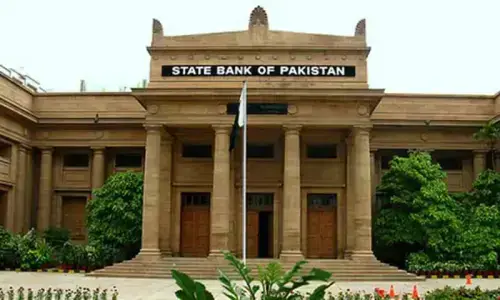
The rupee closed at 239.94, down 3.92, or 1.63pc, according o the State Bank of Pakistan (SBP).
Exchange Companies Association of Pakistan General Secretary Zafar Paracha laid the blame squarely on the country’s political situation and the government’s lack of action.
“The country’s political situation is bad but the government and political parties appear to be unconcerned. They are only concerned with saving their government,” he rued.
Paracha pointed out that ratings agencies had downgraded Pakistan’s outlook while the tranche expected to be released by the International Monetary Fund (IMF) had reportedly been delayed.
In addition, there was uncertainty about whether the Fund’s executive board would demand more actions prior to the tranche’s release.
The real reason for the rupee’s decline was that “we are not doing what we are supposed to do and not taking any practical steps”, he said.
The financial situation had worsened due to mismanagement and lack of attention, the currency dealer said.
In order to stop the rupee’s freefall, the government should incentivise exchange companies and overseas Pakistanis, link imports to exports, and reduce its expenditures, he opined.
“The public is playing its role and paying taxes but those responsible do not seem to be doing anything,” Paracha added.
Mettis Global Director Saad bin Naseer said the reason was the “supply issue” as banks were short of dollars. “The supply is there and remittances are at their regular level but … inflows are not as expected.”
The banks were still giving importers money, he noted. “There is panic in the market, which will remain unless the State Bank of Pakistan (SBP) intervenes.”
Naseer was of the opinion that the SBP would intervene now as the market had reached an “extraordinary level”, after which the panic would start easing.
CEO of Topline Securities, Mohammad Sohail, said one of the reasons behind the rupee’s fall was “reduced interference” by the central bank.
In addition, the government may be allowing the local currency to be weakened to curtail imports, he added.
He also cited the political situation in the country for the sustained pressure on the rupee, adding that it may remain till the release of the IMF tranche.
Pressure on rupee to vanish soon: Miftah
Earlier this week, Finance Minister Miftah Ismail said the pressure on the rupee would “vanish” in a couple of weeks.
In a one-on-one conversation with Mosharraf Zaidi, CEO of advisory services firm Tabadlab, Ismail said the inflows of dollars into Pakistan would soon be higher than the outflow, resulting in a stable exchange rate.
“Nobody is happy with surgery, but sometimes it’s necessary,” he said while defending his policy of import curtailment to reduce the dollar outflow — a measure that may slow down economic growth and reduce tax collection at the import stage.
He repeatedly insisted that the fears of a sovereign default were overblown and that the policymakers knew “all the balls that (they) have in the air” i.e. expected inflows of the foreign currency in the next quarter or so.
“This is what I’m trying to do: moderate our purchases (imports) and not slow down our exports. For two to three months, I’m going to do that. (With every passing) week, I have a greater handle on the foreign currency,” he said.
Rupee’s decline
Since the inception of the new government in Islamabad in the beginning of the second week of April, the dollar has appreciated by over 28pc or Rs51.
Between April 7 (when the then-prime minister Imran Khan was ousted from power) and July 22, the rupee lost 21.3 per cent value against the US dollar both due to the yawning trade deficit and the growing political instability and uncertainty.
The rupee had appreciated to Rs204.56 in the first week of July after touching 211.93 on June 22. It then kept losing its value against the dollar but registered a minor appreciation when the country reached its staff-level agreement with the IMF on July 15.
It has continued to fall in every session since then.
Last week, the rupee lost 8.25pc of its value against the US dollar within a week: it closed to an all-time low of 228.36 per dollar on July 22 from 210.95 per dollar on July 15.
In the opening session this week, the rupee further fell to Rs229.88.
The importers are unable to arrange dollars for imports while the State Bank of Pakistan is unable to improve its foreign exchange reserves still below double-digit.