Teachers call off protest after talks with Sindh education minister: officials


A group of teachers who had been protesting outside the Karachi Press Club (KPC) over the non-regularisation of their jobs have called off their protest after successful talks with Sindh Education Minister Syed Sardar Ali Shah, officials said on Tuesday.
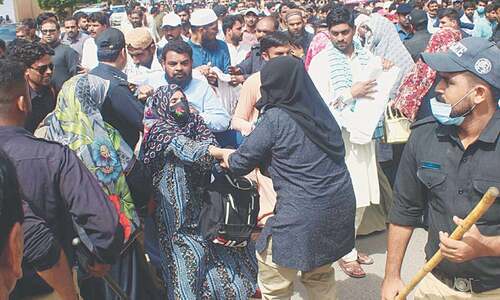
A day earlier, police baton-charged and detained around three-dozen teachers as they attempted to march on the Chief Minister's House from the Karachi Press Club. A video of a female constable manhandling one of the protesters was widely shared on social media.
The education minister invited a delegation of the teachers to his office today. "After successful talks with the education minister, Syed Sardar Ali, the teachers have ended their protest outside the KPC," Senior Superintendent of Police (SSP) South Asad Raza told Dawn.com.
The education minister's spokesperson, Saeed Memon, in a brief statement also said the teachers ended their protest after talks with the minister without elaborating further.
Saddar Superintendent of Police (SP), Ali Mardan Khoso, told Dawn.com that the education authorities have "promised" the protesting teachers that their demands would be fulfilled within one month.
'No leniency' for constable
SSP Raza said the female constable who "tortured" the teacher had been suspended and departmental action was being taken against her.
Separately, a police spokesperson in a statement regretted and condemned the manhandling but said that an entire institution should not be held responsible for an individual's act.
Accountability was an ongoing process and in this case, no leniency would be shown to the lady constable, he added.
Describing the circumstances which led to the incident, the police spokesperson said the teachers had "abandoned the peaceful protest" and attempted to enter the Red Zone when the police took them into "protective custody" to prevent them from moving further.
"All the detained employees were released on the condition that they would not try to enter the Red Zone again and would restrict their protest within limits of the KPC.
"Sindh police's officers and employees consider torture as condemnable and unacceptable," concluded the police statement.
The teachers told reporters on Monday they passed required tests and were appointed on a contract basis in 2018, but despite the passage of three years, their services were not being regularised, prompting them to initiate a protest.
They claimed that they were holding a peaceful protest but the police subjected them to torture and detained their colleagues, including women.