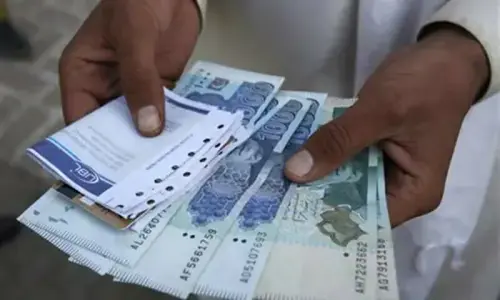
ISLAMABAD: As Pakistan’s exports to Afghanistan saw a deeper drop since the Taliban took control of Kabul in August 2021, the government on Tuesday took a major decision to allow trade of all products to Kabul in the rupee via land routes owing to the non-availability of tradable currency through banking channels.
The change in trade regime from dollar to rupee is considered to be one of the steps to reverse the downward trend in the coming months.
The Economic Coordination Committee (ECC) of the Cabinet approved a summary of the commerce ministry amending the Import Policy Order (IPO) to allow trade with Afghanistan in rupees for a period of one year. It is believed the regime will remain in place until the restoration of regular banking channels in Afghanistan.
The ECC approved amended paragraph 3(1) of the IPO 2022 to allow the import of goods of Afghan origin against the rupee and without the requirement of Electronic Import Form (EIF) forms for a period of one year, subject to the condition that Afghan exporters will provide a Certificate of Origin issued by Afghan Customs proving that the goods have originated from Afghanistan.
ECC approves trade in rupees to check falling exports
The government uses EIF as a tool to monitor the source and outflows of foreign remittances and checks the goods that are imported without foreign exchange through the State Bank of Pakistan.
Currently, the government has allowed exports of two dozen products including fruits, vegetables, and cement to Afghanistan in rupee.
Afghanistan was the third largest export destination for Pakistani products, but the trend changed in the past couple of years. Pakistan’s exports to Afghanistan fell by 30 per cent to $717.53 million in 2021-22 from $1.018bn in 2020-21.
Since Aug 15, 2021, when the Taliban took over and declared their rule over Afghanistan, Islamabad has offered Kabul — among other humanitarian assistance — waivers of duty and taxes on fresh and dried fruits, vegetables and several other products.
As a result of this decision, the import of commodities from Afghanistan posted an unprecedented increase. Pakistan’s trade surplus with Afghanistan turned into a deficit and a robust increase was seen in imports since the Taliban took over the government.
The imports from Afghanistan reached $801.28m in FY22 compared to $583.59m over the previous year, showing an increase of 37pc. In the year 2019-20, imports from Afghanistan were just $470.9m.
The data show that the massive imports from Afghanistan lead to dollar outflows and cause undue pressure on the rupee. Moreover, the smuggling of dollars is believed to be another factor for continuing trade in the greenbacks.
The government’s decision to allow exports of selected items in rupee did not achieve the desired results as exports saw a steep fall in one year.
Currently, the government has already allowed exports of rice, fish and fish products, poultry, meat and products, sugar confectionery and bakery products, fruit, nuts and other edible parts of plants, oilcake and other solid residues, vegetable materials and vegetable waste, salt, cement, pharmaceuticals, matches, textile and textile articles, building stone, surgical instruments, dairy products are allowed in Pakistan currency.
On Jan 22, Pakistan allowed the export of another 14 items to Afghanistan in rupees via land routes. The decision has helped the Taliban-led regime continue the import of essential food items from Pakistan until the West recognises their government.
Published in Dawn, July 6th, 2022