LONDON: Climate change could see four per cent of global annual economic output lost by 2050 and hit many poorer parts of the world disproportionately hard, a new study of 135 countries has estimated.
Ratings firm S&P Global, which gives countries credit scores based on the health of their economies, published a report on Tuesday looking at the likely impact of rising sea levels, and more regular heat waves, droughts and storms.
In a baseline scenario where governments largely shy away from major new climate change policies — known as ‘RCP 4.5’ by scientists — lower- and lower-middle income countries are likely to see 3.6 times greater gross domestic product losses on average than richer ones.
Bangladesh, India, Pakistan and Sri Lanka’s exposure to wildfires, floods, major storms and also water shortages mean South Asia has 10pc-18pc of GDP at risk, roughly treble that of North America and 10 times more than the least-affected region, Europe.
Pakistan among four nations exposed to wildfires, floods, storms and water shortages
Central Asia, the Middle East and North Africa and Sub-Saharan Africa regions all face sizable losses too. East Asia and Pacific countries face similar levels of exposure as Sub-Saharan Africa, but mainly because of storms and floods rather than heatwaves and drought.
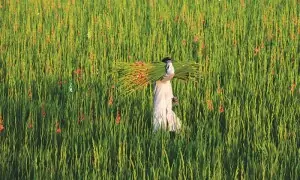
Countries around the equator or small islands tend to be more at risk, while economies more reliant on sectors such as agriculture are likely to be more affected than those with large service sector.
For most countries, exposure to, and costs from climate change are already increasing. Over the past 10 years, storms, wildfires, and floods alone have caused losses of around 0.3pc of GDP per year globally according insurance firm Swiss Re.
The World Meteorological Organisation also calculates that, on average, a weather, climate, or water-related disaster has occurred somewhere in the world every day for the last 50 years, causing 115 deaths and over $202 million losses on a daily basis.
Published in Dawn, April 28th, 2022