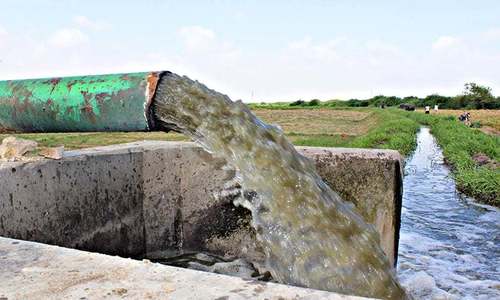
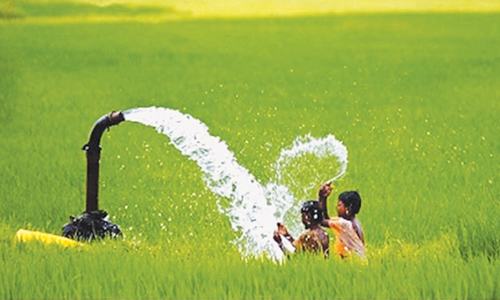
PAKISTAN’S policy has traditionally focused on the surface water of the Indus basin, often at the cost of managing groundwater. This is perilous as both sources are inextricably linked and cannot be separated sustainably. Policymakers have pursued inconsistent water, agriculture, climate and urban planning policies, even if a battery of innovative pilot projects awaits upscaling. They need to offer investment policies and a coherent narrative to pursue ‘conjunctive management’, a catchphrase for the coordinated use of surface water and groundwater to maximise yield.
Our groundwater map is changing fast. In the last 50 years, Pakistan’s reliance on groundwater has at least tripled, making the country the world’s fourth largest groundwater user, following three much larger countries — China, India and the US. Our size, population and economic productivity cannot justify this heavy reliance on groundwater, particularly since it is unregulated, used freely and inefficiently, and has no mechanism to recharge the steeply falling water tables. Once the water bank of poor farmers and rural communities, groundwater is now depleted and polluted commercially by large landowners, industrial users, bottlers, and urban water supply managers.
In the last 50 years, Pakistan’s reliance on groundwater has at least tripled.
Two factors are particularly important to understand the nature of the changing groundwater map.
First, the Indus Waters Treaty is only about surface water. It does not even mention ‘groundwater’. Hence, the aquifers came under stress in the basin areas of three eastern rivers given to India under the treaty — Ravi, Beas and Sutlej. The new command canal system helped with the recharging and absorbing the setback at least seasonally as the flowing water seeped in. In fact, the canals increased the groundwater levels to an extent never recorded before, resulting in salinity and degradation of water quality. But then, as the ruthless abstraction from shallow and deep aquifers increased, water tables began to fall again.
Read: Who owns groundwater in water-stressed Pakistan?
The recharging, however, does not happen the same way in non-irrigated areas or in non-monsoon areas. The challenges vary from the upper Indus basin in the north to the coastal areas of Sindh in the south. Hence groundwater is depleting in all areas of the country, sometimes resulting in the loss of livelihood or even outward migration. The rainfall patterns and monsoon floods cannot cope with this speed, especially now when climate change has begun to bring uncertainties in monsoon patterns in terms of their timing, location and quantity of downpour.
Second, Pakistan has over-allocated its water resources to agriculture and the remaining quantities cannot meet domestic and commercial needs. This inadvertent void created over several decades has left the end users with little option but to become their own water managers and access groundwater at will. A closer look at the water budget reveals that almost 95 per cent of Pakistan’s total surface water is used for agriculture; barely 5pc is left for domestic and commercial purposes.
On the other hand, almost half of Pakistan’s groundwater is used for domestic purposes, mostly in the urban areas. In Punjab, for example, about 70pc of the groundwater is said to be used for drinking and other domestic and commercial purposes. Punjab’s heavily degraded groundwater meets some 90pc of the province’s drinking water requirements. This unregulated access, with over 1.2 million tube wells and millions of individual pumping machines belonging to urban residents, have seriously degraded water quality in every nook and corner of the country. A recent study of some selected cities in Punjab, including Lahore, Multan, Sahiwal, Bahawalnagar, Lodhran and Okara, found the water quality to be unfit for drinking and agriculture as it affected human health and the food chain. Overmining and pollution has resulted in secondary salinisation and the presence of fluoride and arsenic in water that are degrading the quality of agricultural land.
Climate change has emerged as a major threat multiplier for both surface water and groundwater — and their dynamic interaction. Several studies show that climate change causes extreme events such as floods and droughts. As the streams or tributaries disappear or their flows reduce, the groundwater-charging pattern also undergoes changes. In parts of Pakistan, periods of drought are becoming more frequent and prolonged, as we recently witnessed in several districts of Balochistan and Sindh. Studies have shown linkages between the vulnerability to droughts and the reduced soil moisture because of the dropping water table.
Lower water tables also make an area prone to heatwaves. Punjab and Sindh have received heatwaves for centuries, but climate change is making them longer, stronger and more frequent, particularly in areas that have lower water tables. A drought can make a hot day hotter, while a heatwave can make dry conditions even drier. Scientists are now making the case that heatwaves and droughts are more likely to overlap, further reducing the soil moisture where water tables are already very low because the groundwater provides a cushion against heatwaves. It moistens the soil and supports greater transpiration. Droughts, on the other hand, intensify heatwaves. If there is less moisture in the soil it is likely to evaporate because of the heat generated by the sun and soil.
This situation is compounded by several factors, which make it imperative for the federal and provincial governments to dust off the National Water Policy that was approved in 2018. In the policy that was signed off on by the PTI, PPP and PML-N, each province committed itself to creating a groundwater authority to establish and enforce standards for utilisation. No action has been taken except in Punjab that has just started the process at the irrigation department.
All provinces agreed to regulate groundwater withdrawals for curbing overexploitation and promoting aquifer recharge and to strengthen monitoring and prepare water budgets for sub-basins and canal commands. The policy has recognised that it is critical to prevent the movement of saline water to curb degradation of sweet water, by using technologies that exist to skim fresh groundwater overlying saline water. The provinces have already committed to prepare a groundwater atlas for each command and sub-basin area. There is no better way for Pakistan to commemorate World Water Day, that was observed on March 22, than to stop sleepwalking and, instead, capture a watershed moment for Pakistan in this period of turmoil and transition.
The writer is an expert on climate change and development.
Published in Dawn, March 27th, 2022