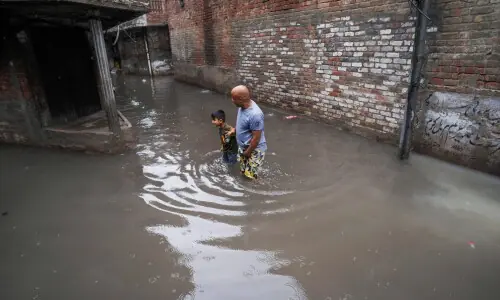
LAHORE: Not just the air but also the river flowing through Punjab’s capital has been found to be the world’s most polluted, with active pharmaceutical ingredients posing a ‘threat to environment and human health’.
A study on pharmaceutical pollution of the world’s rivers conducted at the University of York and published by Proceedings of the National Academy of Sciences of the US detected pharmaceutical particles including paracetamol, nicotine, caffeine and epilepsy and diabetes drugs in the river.
It placed waterways in Lahore, Bolivia and Ethiopia among the most polluted while rivers in Iceland, Norway and the Amazon rainforest fared the best.
Expressing concern over the latest findings about river pollution, environmentalist Afia Salam said the River Ravi had been turned into a drain with human and industrial wastes. “We have laws about dumping wastewater and industrial wastage but no law is being implemented in the country,” she said, adding that if the government implemented the waste disposal laws, it would bring betterment in ground and river water.
“Also the current government is planning to build a city on the river basin [Ravi Riverfront Urban Development Project] and it would also increase pollution,” she regretted. Besides, she said, India was also creating problems for the Ravi by diverting the Hudiyara drain towards River Ravi.
Lahore Conservation Society Information Secretary Dr Ajaz Anwar told Dawn that under the Indus Water Treaty, India had stopped pure water and had thrown wastewater in the Ravi. “We also have diverted untreated wastewater into the river besides dumping waste in and around the basin of the river,” he added.
He said future generations might be able to see natural water flow in the river when dams were built on the river.
Referring to the government plans to build a new city, Ravi Riverfront Urban Development Project, Dr Anwar said he was planning to launch a protest campaign against the move. “How could you build a city on agricultural land? And it would also disturb the water level of the Lahore city,” he added.
In a recent recorded video, Prime Minister Imran Khan had said the Ravi Riverfront project would turn around the economy and benefit some 40 industries, offer hundreds of jobs and bring in much-needed foreign exchange. “Around $1.5 billion foreign investment has already reached Pakistan for this project,” he said.
“The project is not about establishing housing societies, but creating a new planned city after Islamabad,” he had said, while explaining that the project would save the Ravi, because wastewater treatment plants would be installed to treat sewage before draining it into the river.
According to an Asian Development Bank report on River Ravi revitalization plan, the condition of the River Ravi and its nullahs is a “serious threat to the health” of basin residents. “Widespread contamination means water-borne and water-washed (skin) diseases are common across all age groups. If nothing is done, spread of disease will most likely get worse.”
It pointed out that rapid urbanization, high industrialization and lack of wastewater treatment caused large amounts of wastewater and toxic effluents flow directly from urban areas like Lahore, Sheikhupura and Faisalabad into the River Ravi.
The latest study by the University of York on pharmaceutical pollution of the world’s rivers found Lahore’s River Ravi the most polluted in the world posing a ‘threat to environment and human health’.
The study collected surface water samples in duplicate once from 1,052 sampling sites during 137 sampling campaigns covering 104 countries across all continents and analysed for 61 active pharmaceutical ingredients (APIs), resulting in 128,344 data points. A sampling campaign comprised the collection of water samples at a number of sampling sites along a river or rivers flowing within a city, a town, or local area.
Cumulative pharmaceutical concentrations were calculated at each sampling site as the sum of all API residues quantified at that specific location. The mean of the cumulative concentrations was then determined across all the sites within a sampling campaign.
The highest mean cumulative concentration was observed in Lahore at 70.8 µg/L, with one sampling site reaching a maximum cumulative concentration of 189 µg/L.
This was followed by Bolivia’s La Paz (68.9 µg/L mean, 297 µg/L maximum) and Ehiopia’s Addis Ababa (51.3 µg/L mean, 74.2 µg/L maximum). The most polluted sampling site was located in the Rio Seke (La Paz, Bolivia) and had a cumulative API concentration of 297 µg/L (Dataset S4). This sampling site was associated with both untreated sewage discharge and disposal of rubbish along the bank of the river
On-the-ground observations revealed that the highest API concentrations were observed at sampling sites receiving inputs from pharmaceutical manufacturing, sites receiving discharge of untreated sewage, locations in particularly arid climates, and sites receiving sewage exhaust truck emissions and waste dumping. Sites with lowest API concentrations were typically characterized as having limited anthropogenic influence, limited use of modern medicine, sophisticated wastewater treatment infrastructure and high riverine flows with a large dilutional component.
Additional reporting by Hassan Sheerazi
Published in Dawn, February 16th, 2022