DECADES of fiscal profligacy have trapped the country in a situation where it not only has to borrow more money to return old loans, but must also pay for new import bills. The increasing dependence on foreign loans means that the country is surrendering a bit of its sovereignty every time it approaches lenders for more money.
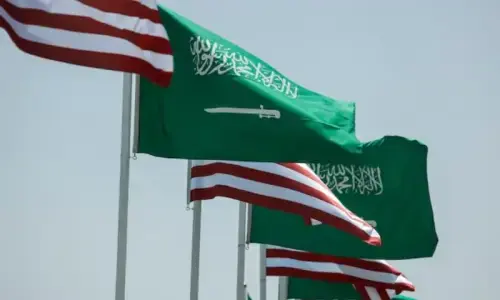
When the federal cabinet on Friday approved the unpleasant conditions of a new Saudi loan amounting to $4.2bn, it had no other choice because of the growing external-sector vulnerabilities. That the Saudis are charging a slightly higher price than before for their ‘assistance’ shouldn’t bother us too much.
After all, they are extending us this favour at a time when our official foreign exchange reserves have gone down from $20.07bn to $16.25bn in the last three months, the rupee has lost 15pc of its value and the current account deficit has crossed $5bn to reach 4.7pc of GDP.
But the other conditions under which Riyadh can demand that Islamabad return the loan on 72 hours’ notice with or without assigning any reason are worrisome. Moreover, in case of a dispute, Saudi law will be applicable.
These conditions mean that the kingdom can ask us to return the money at any time if the two countries have divergent views regarding their relationship or ties with a third country, or some other issue. We saw the risk to a $6.2bn deal given in 2018 when Saudi Arabia pressed for the premature return of a part of it after the foreign minister’s outburst in 2020 against the OIC for its silence on Indian atrocities in held Kashmir.
Earlier, the prime minister was also forced to withdraw from a three-nation summit in Malaysia under pressure from Riyadh. The new Saudi ‘facility’ comes on the heels of an IMF announcement about the agreement with Islamabad on the resumption of its $6bn loan.
The deal is dependent on the implementation of tough ‘prior actions’ Islamabad had earlier refused to execute for fear of a political backlash. This indicates Pakistan’s waning ability to muster more debt without significantly compromising on its sovereignty.
It also underscores the fact that we are not yet ready to change ourselves. Pakistan’s excessive external indebtedness has deep structural roots; we will not come out of the debt trap unless we decide to revamp the economy, mobilise tax and non-tax revenues to match our expenditure needs, and boost our industrial exports.
Published in Dawn, November 30th, 2021