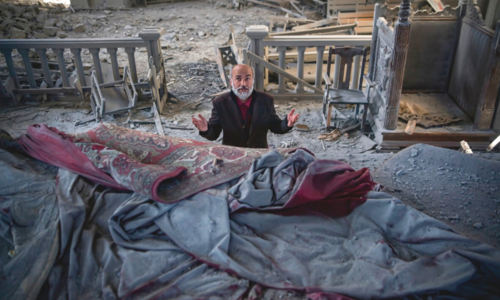
Putin hosts Azeri, Armenian leaders in bid to defuse tensions
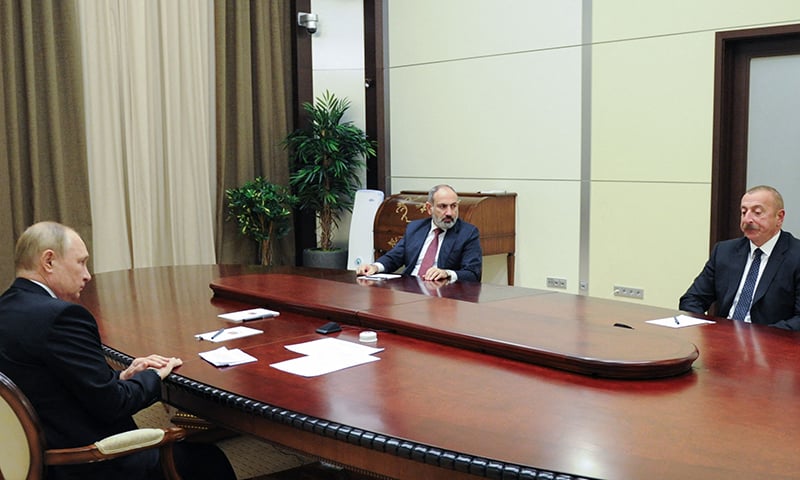

MOSCOW: Russian President Vladimir Putin on Friday hosted the leaders of regional rivals Armenia and Azerbaijan for talks marking the first anniversary of a Moscow-brokered peace deal that ended fighting in the separatist region of Nagorno-Karabakh.
In the southern city of Sochi, Putin held a bilateral meeting with Azerbaijan’s President Ilham Aliyev. Then the Russian president met with Aliyev and Armenia’s Prime Minister Nikol Pashinyan together, and after that he said he would have a separate bilateral meeting with Pashinyan.
Opening the meetings, Putin said a lot has been done over the past year, but not all the issues are yet resolved. He pointed to repeated clashes on the border between the two nations that resulted in multiple casualties.
The goal, a year into the truce, is to create conditions for the revival of the region, so that people can feel safe there and be able to carry out normal economic activities ... develop the economy, Putin stressed.
Armenia and Azerbaijan have been locked in a decades-old dispute over Nagorno-Karabakh, a region that lies within Azerbaijan but was under the control of ethnic Armenian forces backed by Armenia since a separatist war there ended in 1994.
The Azerbaijani military routed the Armenian forces in 44 days of fierce fighting in the fall of 2020, which ended with a Russia-brokered peace deal that saw Azerbaijan gain control of a significant part of Nagorno-Karabakh and reclaim all the regions controlled by Armenian forces outside the separatist region.
Russia has deployed nearly 2,000 peacekeepers for at least five years to monitor the peace deal.
The peace agreement was celebrated as a triumph in Azerbaijan but was seen as a betrayal by the opposition in Armenia. Pashinyan defended it as the only way to prevent the Armenian forces from losing control over the entire Nagorno-Karabakh region.
The 2020 deal envisaged a transport corridor via Armenia that would link Azerbaijan with its exclave of Nakhchivan region a plan resented by the Armenian opposition, which also fears that Armenian interests could be compromised by the planned demarcation of the border.
Putin on Friday said Armenia, Azerbaijan and Russia achieved a lot in a year that passed since the peace deal was signed.
Published in Dawn, November 27th, 2021