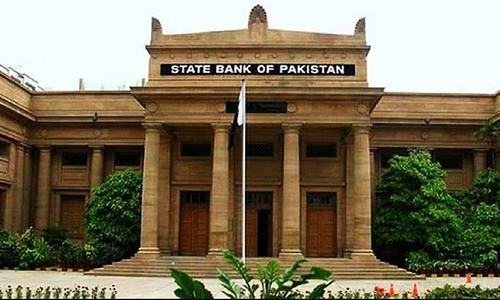
THE State Bank’s decision to boost its interest rate by a hefty 150bps to 8.75pc signifies a shift in the government’s policy pivot from growth to stabilisation to close the deal with the IMF for the early resumption of the $6bn loan facility.
The central bank in its monetary policy statement says the decision is driven by heightened risks to inflation and the balance of payments. But these aren’t the only reasons.
When the bank started tapering its monetary stimulus in September by raising the policy rate by 25bps to 7.25pc, the risks to inflation and the balance of payments were already apparent. Yet it decided to move gradually so as not to rock the growth boat because the government thought it could still convince the IMF about the sustainability of its budget and get its own way. But the Fund refused to sign the deal unless Islamabad took prior actions to shift from the growth to stabilisation gear.
Monetary tightening is one of five prior actions demanded by the lender, whose support is imperative for securing assistance from other multilateral institutions and raising funds from international bond markets.
Other actions include changes in the SBP Act to free the bank from the finance ministry’s influence, an increase in electricity prices, and fiscal consolidation through increased tax revenue and cuts in development spending.
Hence, the bank brought forward the monetary policy committee meeting by a week to “help reduce the uncertainty about monetary settings” and to bolster the cost of money that exceeded market expectations.
But will the hike tame inflation? Theoretically, inflation and interest rates are inversely linked. Monetary tightening is perhaps the most important tool available with central bankers to control inflation by contracting the money supply when needed. Interest rates reflect the overall economy.
Generally, when they are low, the economy grows and inflation increases, and vice-versa. Even though the monetary policy statement sees “emerging signs of demand-side pressures on inflation” for the first time since March 2020, the escalation in international commodity prices and administered prices of energy are the primary factors behind the runaway domestic prices.
How much higher interest rates can help decelerate energy, food and other essential imports contributing to “higher-than-expected inflation out-turns” and curb the demand for dollars is anybody’s guess.
That isn’t all. Higher interest rates must be complemented by fiscal tightening to leave an impact on inflation. That much is emphasised by the SBP in its statement: “Looking ahead, it will be important to achieve fiscal consolidation planned in the budget to help restrain domestic demand. A higher-than-planned primary fiscal deficit would likely worsen the outlook for inflation and the current account, and would undermine the durability of the recovery.”
In sum, the pain of monetary and fiscal policies aimed at taming inflation will be as excruciating for the people as the pain caused by soaring prices.
Published in Dawn, November 21st, 2021