Taliban taking halting steps to gain legitimacy, says UN envoy

UNITED NATIONS: Pakistan has alerted the international community that Afghanistan was on the verge of a complete economic collapse while a senior UN official said that Kabul’s Taliban rulers had started taking ‘halting steps’ to gain legitimacy.
“The larger crisis that is looming is the danger of a complete economic collapse,” said Pakistan’s UN ambassador Munir Akram while participating in a UN Security Council (UNSC) debate on Afghanistan.
“Cash is needed to revive the economy — to pay salaries, restore small businesses, revive the banking system.”
UN special representative for Afghanistan Deborah Lyons also expressed similar sentiments, warning that the country’s GDP could contract by 40pc this year while 60 percent of its 38 million people could face hunger.
Ms Lyons, however, noted that despite a crisis of trust both within the country and abroad, the interim Taliban government had started taking halting steps to pursue international legitimacy.
“Ultimately, the Taliban must decide on whether to govern according to the needs and rights of the diverse Afghan population, or whether to rule on the basis of a narrow ideology and even narrower ethnic base,” said Ms Lyons, who also heads the UN Assistance Mission in Afghanistan (UNAMA). “Afghans feel abandoned by the international community and anxious about their new leadership.”
Pakistan welcomed the establishment of the UN’s Special Trust Fund and called for quickly setting up a similar mechanism to stabilise the Afghan economy and to lift “the unjustified freeze” on Afghanistan’s assets.
“The consequences of an economic collapse in Afghanistan will be horrendous; massive human suffering, the outflow of millions of additional Afghan refugees, chaos and further conflict and reinforcement of Daesh and other terrorist groups,” Ambassador Akram said.
Ms Lyons warned that the “paralysis of the banking sector (could) facilitate terrorism, trafficking and further drug smuggling” that will first affect Afghanistan and then “infect the region”.
The Taliban, she said, had failed in stemming the expansion of the militant Islamic State (IS) group, “which now seems to be present in nearly all provinces and is increasingly active.”
The Chinese and Russian ambassadors also urged the unfreezing of Afghanistan’s reserves, but US deputy ambassador Jeffrey DeLaurentis made no mention of sanctions in his address.
He criticised the Taliban for choosing a battlefield victory over a peaceful settlement and were now facing the consequences of this choice.
“But the Afghan people should not have to pay twice for the Taliban decision,” he said, pointing out that the United States was the largest humanitarian donor to Afghanistan, with $474m in aid provided in 2021.
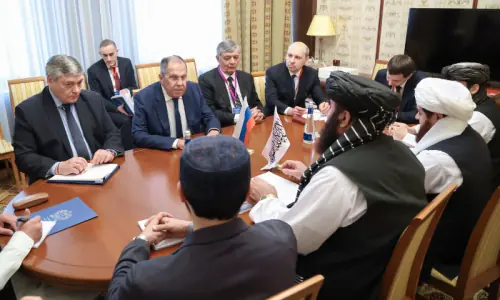
Ambassador Akram informed the Security Council that the Extended Troika grouping of China, Pakistan, Russia and the US met in Islamabad earlier this month and interacted with the visiting acting Afghan Foreign Minister.
“The meeting conveyed the Troika’s expectations on inclusivity; human rights; girls’ education and women’s participation,” he said, while urging the Taliban not to take vengeful actions against former government officials; eliminate terrorist organisations and control drug trafficking.
“Unfortunately, there are some in our region which, for narrow national reasons, continue to play the role of a spoiler in Afghanistan,” said the ambassador without naming the neighbor.
“They are still involved in schemes to destabilize Afghanistan. They must be isolated and exposed.”
The Pakistan envoy argued that the nightmare scenarios feared after the Aug 15 Taliban takeover of Kabul “have not come to pass,” as “there has been no widespread violence or violation of human rights” and “the security situation has vastly improved.”
“The glass may yet be half full; but engagement has yielded progress on several concerns of the international community,” he said. “Girl schools up to the level of grade six are open and women are attending universities in segregated classes.”
Published in Dawn, November 19th, 2021