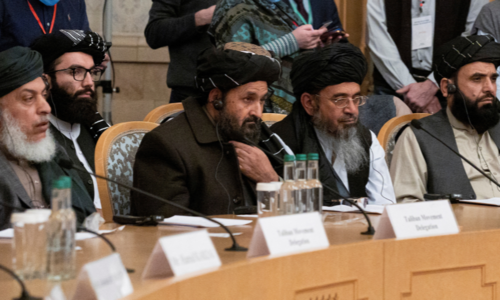
New Taliban government begins work as protests grow


A new Taliban interim government drawn exclusively from loyalist ranks formally began work on Wednesday, with established hardliners in all key posts and no women — despite previous promises to form an inclusive administration for all Afghans.
As they transition to governing power, the Taliban are already facing opposition to their rule, with scattered protests — many with women at the forefront — breaking out in cities across the country.
After leading a virtual 20-nation ministerial meeting on the Afghan crisis, US Secretary of State Antony Blinken said any international legitimacy for the Taliban government would have to be “earned”.
In the capital Kabul, a small rally on Wednesday was quickly dispersed by armed Taliban security, while Afghan media reported a protest in the northeastern city of Faizabad was also broken up.
Hundreds protested on Tuesday, both in the capital and in the city of Herat, where two people at the demonstration site were shot dead.
Late on Wednesday, the Taliban moved to snuff out further protests, issuing an order saying prior authorisation will be needed from the justice ministry — and warning that violators “will face severe legal action”.
And “for the time being”, demonstrations are not allowed — at all.

The announcement of the government on Tuesday night was a key step in the Taliban's consolidation of power over Afghanistan, following a stunning military victory that saw them oust the US-backed administration on August 15.
Notorious for their brutal and oppressive rule from 1996 to 2001, the Taliban had promised a more inclusive government this time.
However, all the top positions were handed to key leaders from the movement and the Haqqani network — the most violent faction of the Taliban known for devastating attacks.
'Same as the old Taliban'
Mullah Mohammad Hassan Akhund — a senior minister during the Taliban's reign in the 1990s — was appointed interim prime minister, the group's chief spokesman announced.
Mullah Yaqoob, the son of the Taliban founder and late supreme leader Mullah Omar, was named defence minister, while the position of interior minister was given to Sirajuddin Haqqani, the leader of the feared Haqqani network.
The movement's co-founder Abdul Ghani Baradar, who oversaw the signing of the US withdrawal agreement in 2020, was appointed deputy prime minister.
Read: Who are the key figures in the new Taliban government?
None of the government appointees were women.
“We will try to take people from other parts of the country,” spokesman Zabihullah Mujahid said, adding that it was an interim government.
But Bill Roggio, managing editor of the US-based Long War Journal, tweeted: “The new Taliban, same as the old Taliban”.
Legitimacy must be 'earned'
The Taliban had made repeated pledges in recent days to rule with greater moderation than they did in their last stint in power.
But Zabihullah announced the reinstatement of the feared Ministry for the Promotion of Virtue and Prevention of Vice — which from 1996 to 2001 was responsible for arresting and punishing people for failing to implement the Sharia (Islamic laws).
Even as the Taliban consolidate power, they face the monumental task of ruling Afghanistan, which is wracked with economic woes and security challenges — including from the militant Islamic State group's local chapter.
Read: 5 challenges for the Taliban in Afghanistan
In Germany, Blinken said the ministerial talks were the “starting point for international coordination” on how to deal with the Taliban.
Among the countries that participated in the virtual meeting were European allies and Pakistan.
“The Taliban seek international legitimacy. Any legitimacy — any support — will have to be earned,” Blinken told reporters.
The European Union said the “caretaker” government failed to honour vows from the new rulers to include different groups.
China meanwhile said it welcomed the end of “three weeks of anarchy”, adding it “attaches great importance” to the announcement of an interim government.
Foreign ministry spokesman Wang Wenbin said China hoped the Taliban would “pursue moderate and steady domestic and foreign policies, resolutely crack down on all kinds of terrorist forces, and get along well with all countries, especially neighbouring countries”.
Qatar, the central intermediary between the Taliban and the international community in recent years, said the Taliban had demonstrated “pragmatism” of late.
“Let's seize the opportunities there,” Assistant Foreign Minister Lolwah al-Khater told AFP in an exclusive interview, but she stopped short of announcing formal recognition of the government.
Former president Ashraf Ghani, who fled the country on August 15 as the Taliban entered Kabul, apologised on Wednesday to the Afghan people for how his rule ended.
Ghani said he left at the urging of the palace security in order to avoid the risk of bloody street fighting, and again denied stealing millions from the treasury.
“I apologise to the Afghan people that I could not make it end differently,” he said on Twitter.