India lashes out at UNGA chief over 'misleading' remarks on Kashmir issue



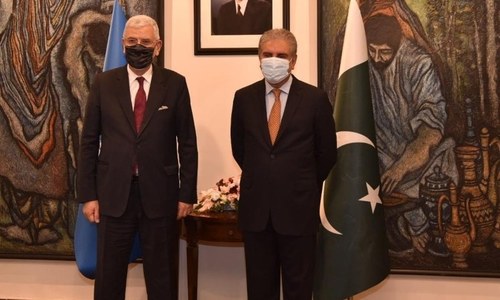
United Nations General Assembly (UNGA) President Volkan Bozkir's recent visit to Islamabad has drawn backlash from across the border after the Indian Ministry of External Affairs (MEA) voiced objections to the former's "misleading and prejudiced remarks" on the Kashmir issue.
During his three-day visit, the UNGA chief — in a press conference alongside Foreign Minister Shah Mahmood Qureshi — had said that it was Pakistan's duty to bring the issue of Jammu and Kashmir to the UN platform with more vigour.
Bozkir had lamented what he said was a lack of large political will for the resolution of the Kashmir issue compared to the Palestinian issue which had more will behind it.
"I think it is the duty, especially Pakistan's, to bring this [issue] to the UN platform more strongly," Bozkir had said, adding that he agreed that the Palestinian issue and the Kashmir issue were of the same age.
Editorial: The UNGA chief is correct in saying more can be done to highlight the Kashmir issue
He had called on all parties to refrain from changing the status of Jammu and Kashmir and said a solution was to be found through peaceful means in accordance with the UN charter and UN Security Council (UNSC) resolutions as agreed in the Simla Agreement between Pakistan and India.
Reacting to the press conference, MEA spokesperson Arindam Bagchi said India had “expressed strong opposition” to Bozkir’s comments.
“His remarks that Pakistan is ‘duty bound’ to raise this issue in the UN more strongly are unacceptable. Nor indeed is there any basis for comparison to other global situations,” the Indian spokesperson said.
“When an incumbent president of the UNGA makes misleading and prejudiced remarks, he does great disservice to the office he occupies. [Bozkir's] behaviour is truly regrettable and surely diminishes his standing on the global platform,” he added.
Pakistan rejects Indian FM's allegations of 'cross-border infiltration'
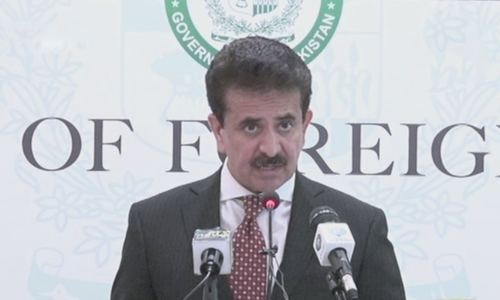
On Thursday, Foreign Office spokesperson Zahid Hafeez Chaudhri said in a statement that Pakistan "categorically rejected the allegations of any cross-border infiltration [from Pakistan]", countering instead that it was New Delhi's "brutalisation of Kashmiri people" that threatened regional peace.
Chaudhri was responding to comments made by Indian External Affairs Minister (EAM) Subrahmanyam Jaishankar at Stanford University's Hoover Institution a day earlier in which he claimed that firing incidents across the Line of Control (LoC) had taken place because of "infiltration by Pakistan".
Rejecting the Indian foreign minister's allegations, Chaudhri said, "Peace and security in the region [are] threatened on account of India's brutalisation of Kashmiri people and refusal to resolve the Jammu and Kashmir dispute in accordance with the United Nations Security Council resolutions, [and] its own pledges to the international community and the Kashmiris."
The FO spokesperson added that it was Kashmir that was the "core outstanding issue between Pakistan and India" since 1947 which awaited settlement as per international legitimacy.
"India's illegal and unilateral actions of August 5, 2019, in IIOJK were against international law and manifestly anti-peace. The movement against the Indian occupation and its state-sponsored terrorism in IIOJK is indigenous and is likely to continue till India decides to act in accordance with the UNSC resolutions, mandating a free and impartial plebiscite in the occupied territory," the statement quoted Chaudhri as saying.
"Rather than regurgitating insinuations against Pakistan, India will be well advised to create enabling environment for a meaningful and result-oriented engagement for resolution of the Jammu and Kashmir dispute as well as any other issues," the spokesperson added.