Loudest land animal
The howler monkey is the loudest land animal. Its calls can be heard from three miles (five kilometres) away. At its peak, the howler monkey can produce sounds that reach 140 decibels. That’s as noisy as a jet engine, on take off!
They call to let others know where their territory is. The calls sound like a loud whooping bark or roar. After one group of howlers call, another group answers. Howler monkeys usually do this in the morning and at the end of the day.
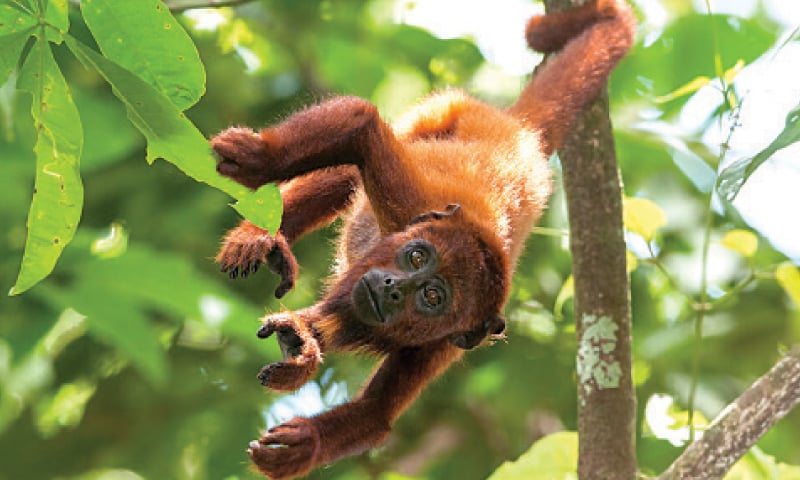
Treetop dwellers
These monkeys live in Central and South America. At home in the forest, they hardly ever leave the treetops or move very far each day. Howlers mainly eat leaves, as well as fruits, nuts, and flowers. Howler monkeys get almost all the water they need from the food they eat. One of the few times they can be spotted on the ground, however, is during very dry spells when they need to find extra water.

By the tail
Howler monkeys have prehensile tails, or tails that can grip.
The monkeys use their tails as a fifth limb to grip branches. Mostly it uses its tail to help grip branches as it eats and moves around high in the trees. Each family group is generally made up of 15 to 20 howlers. The leader is usually an old male.

Music from a spider’s web!
The spider web has music of its own, and Markus Buehler, engineering professor at the Massachusetts Institute of Technology, has been using artificial intelligence to study them.
“Spiders utilise vibrations as a way to communicate with the environment, with other spiders,” he said. “We have recorded these vibrations from spiders and used artificial intelligence to learn these vibrational patterns and associate them with certain actions, basically learning the spider’s language.”
Buehler and his team of researchers created 3D models of spiderwebs when the arachnids were doing different things — such as construction, repair, hunting and feeding. They then listened for patterns in the spider signals and recreated the sounds using computers and mathematical algorithms.
Buehler hopes his team’s work could enable humans to understand the language of a spider and one day communicate with them.
Published in Dawn, Young World, May 1st, 2021