No other govt has spent as much money on Balochistan as PTI has, says PM Imran

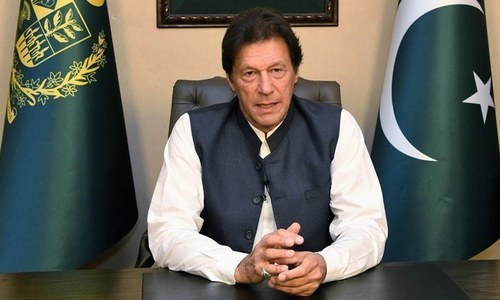
Prime Minister Imran Khan on Wednesday said that no other government had spent as much money on Balochistan's development as the PTI did, sharing that road projects of 3,300 kilometres were initiated during his tenure.
He made the comments while addressing a ceremony in Quetta on a one-day visit to the city. The prime minister also performed the groundbreaking for various projects in Quetta, including 22-km dualisation of Quetta Western Bypass (N-25) and the construction of an 11-km Dera Murad Jamali Bypass (N-65), according to a report by Radio Pakistan.
He also distributed cheques under the Kamyab Jawan Programme.
"I want to say with happiness that we have initiated several projects," Prime Minister Imran said. "In 15 years, [past governments] started projects on 1,100 kilometres, in our tenure we have [covered] 3,300 km."
He said that political parties did not need Balochistan to win the elections which was why the province was neglected. "This was why roads were built only on 1,100km when this province needs connectivity the most," he said, adding that it reflected the mindset of those political parties.
Elaborating on his philosophy, the prime minister said that history remembered those who did something for other people.
"When [the PTI] came into power in Khyber Pakhtunkhwa in 2013, the province was in dire straits because of terrorism. The law and order situation was such that 500 police officers had died and the [force] was demoralised. The business was catching people, taking money and letting them go."
As a result of this, only people with money ever became part of the government in Islamabad, he said, adding that he was advised to focus on the province of Punjab because his party had no chance of coming into power in KP.
In 2018, the PTI won with a two-thirds majority because poverty was "drastically reduced" and investment was done in human development, he highlighted.
Talking about his vision for the country, Prime Minister Imran said that so far, Pakistan's development had been backwards. "What was our stature 50 years ago? ... This country started regressing," he observed.
The premier said a report had noted that there was "elite capture" in Pakistan. "Small provinces get left behind, the poor get poorer," he said. Even the British prime minister was not allowed to buy property in the United Kingdom in the way that Pakistan's former prime ministers had bought, he said in an apparent reference to former premier Nawaz Sharif.
Pakistan would develop when the poor people were lifted up and backward areas were also developed alongside, he said.
Prime Minister Imran said the model of Riyasat-e-Madinah (the state of Madinah) was "unique" in which leaders spent their money on the development of poor people. He cited the same model as the reason for China's development.
"[President] Xi said [China] has eradicated extreme poverty. Technically, they followed the model and China developed its areas."
The prime minister recalled that the PTI government was providing Sehat Cards to people in provinces under it, saying there could be "no bigger blessing for poor people".
The health cards would help improve the system and provide incentives to the private sector to build health facilities in remote areas, he said, terming it as the "biggest step towards a welfare state".
He said the government was also introducing Kisan (farmer) Cards which would give direct subsidies on fertiliser and seeds to small farmers. This would increase productivity, he added.
The government was also mapping the population after which targeted subsidies would be offered to poor people, the prime minister said.
"No one should think about vote bank, we are working on our vision," he concluded.